
Review · JAPAN
Tsukiji Fish Market: Street Food & Culture Walking Tour
Tsukiji wakes your appetite before breakfast. This two-hour walk gives you a local view of Tokyo’s food culture, from street stalls and seafood bowls to a traditional fish-cutting show. I like the chance to see working market activity, and I like that guides such as George and Tomo have been praised for making the food and customs easy to understand. The main catch is pace: crowds, waiting, and a group that can reach 30 people may make the experience feel less personal than the small-group wording suggests.
The tour also includes a visit to Tsukiji Hongwanji Temple, which adds a useful cultural stop before or after the market. Still, I would not book this mainly for a history lesson. The strongest part is tasting your way through the market with someone who can point out ingredients and stalls, while the temple visit is shorter and less central.
Five useful things to know before you go
- The meeting point is easy to identify: Start at Tsukiji Hongwanji Temple, 3-chōme-15-1 Tsukiji, Chuo City.
- The fish-cutting show is the tour’s special feature: A chef fillets a whole fish using traditional methods before a seafood bowl is served.
- Food costs extra: Meals are not included, so bring money for the stalls and any seafood you want to try.
- The group may be larger than expected: The maximum is 30 people, and crowd control can affect how well you hear the guide.
- The route is accessible: The activity is wheelchair and stroller accessible and is near public transportation.
- The best guides add real value: George and Tomo received especially warm praise for food advice, culture, and clear explanations.
Starting at Tsukiji Hongwanji Temple
The meeting point at Tsukiji Hongwanji Temple gives the tour a calm and recognizable start. This matters in a district where narrow streets and busy shopfronts can make a first meeting harder than expected.
The temple visit lasts about 15 minutes. Your guide introduces the building, explains points about Buddhism, and gives some background on Japanese culture. It is a modest portion of the tour, not a full temple visit, but it helps place Tsukiji in a wider cultural setting.
I like beginning here because it gives you a moment to get oriented before the food stalls take over your attention. If you arrive early, the temple is also a clear landmark for finding the group.
The temple stop will not satisfy you if you want a long religious or architectural tour. Some people found it added little compared with the market itself. I would treat it as a short introduction, then save your attention for the food and fish trade.
More Fish Market Tours in Japan
- Tokyo Tsukiji Fish Market Food and Culture Walking Tour
★ 5.0 · 3,184 reviews - Tokyo: Tsukiji Fish Market Food and Walking tour
★ 5.0 · 1,724 reviews - Tokyo: Tsukiji Fish Market Guided Walking Tour
★ 4.9 · 1,397 reviews
Forty-five minutes of Tsukiji street food
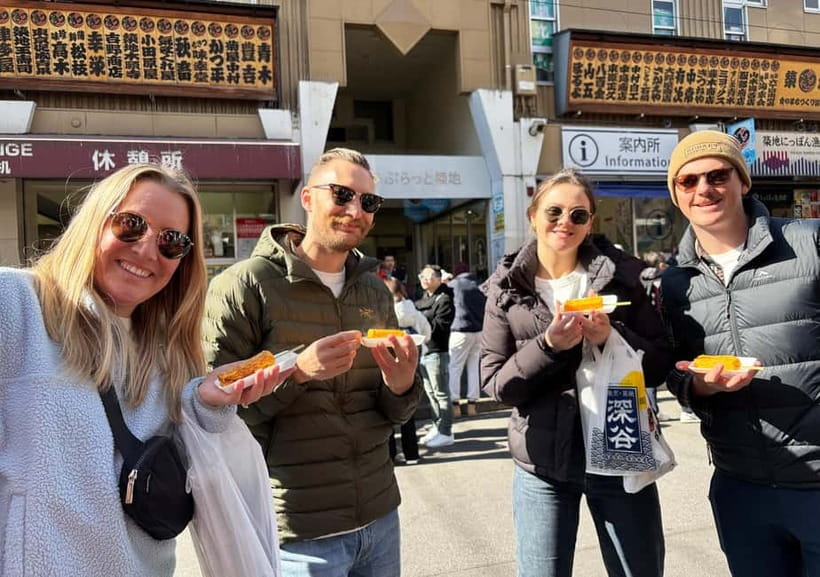
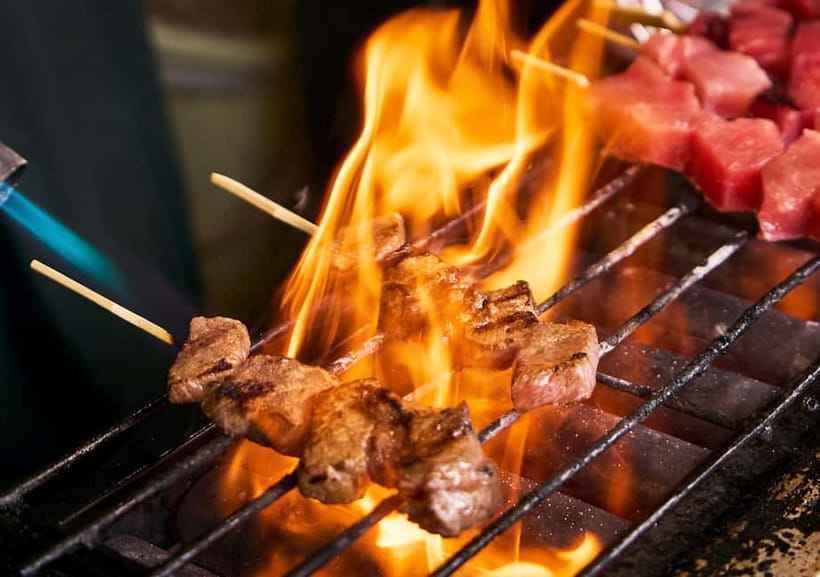
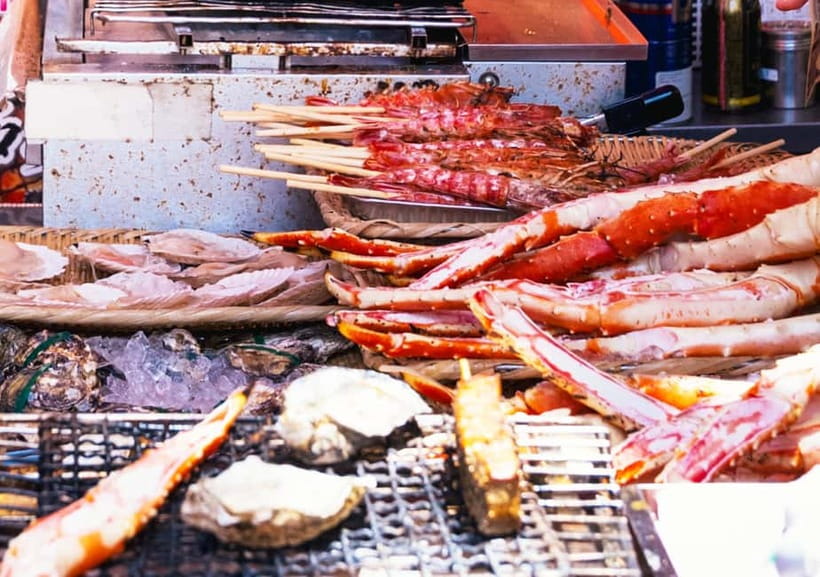
The first substantial section takes place in Tsukiji Jogai Market, the outer market area. You walk with a local guide and learn about Japanese ingredients, cooking customs, and the food sold around the market.
This is where the tour earns most of its price. Tsukiji can be exciting but confusing on your own. A guide can explain what you are looking at, suggest places to eat, and help you decide which foods are worth your limited stomach space.
The experience is built around stopping at food stands rather than sitting down for a formal meal. That means you can see more of the market, but it also means the quality of the experience depends heavily on the guide’s choices and the group’s willingness to stop and sample food.
George was especially praised for taking the group to good spots and helping people choose what to try. Tomo was also praised for explaining food, history, and culture clearly. Those details matter because Tsukiji is not simply a place to point a camera at a row of stalls. The pleasure comes from knowing why an ingredient matters and how it fits into Japanese cooking.
Keep your expectations realistic. Food is not included in the tour price, so the advertised cost is only the guide fee. You may want to buy several small portions, and that can raise the total cost. The tour is best for someone who sees tasting as part of the activity, not for someone trying to keep every yen in their pocket.
Crowds are another factor. Tsukiji can become hectic, particularly around busy holiday periods. One person found that several stalls had to be skipped because the market was too crowded. Stay close to the guide, listen for instructions, and avoid wandering off to photograph every interesting display.
The whole-fish cutting demonstration
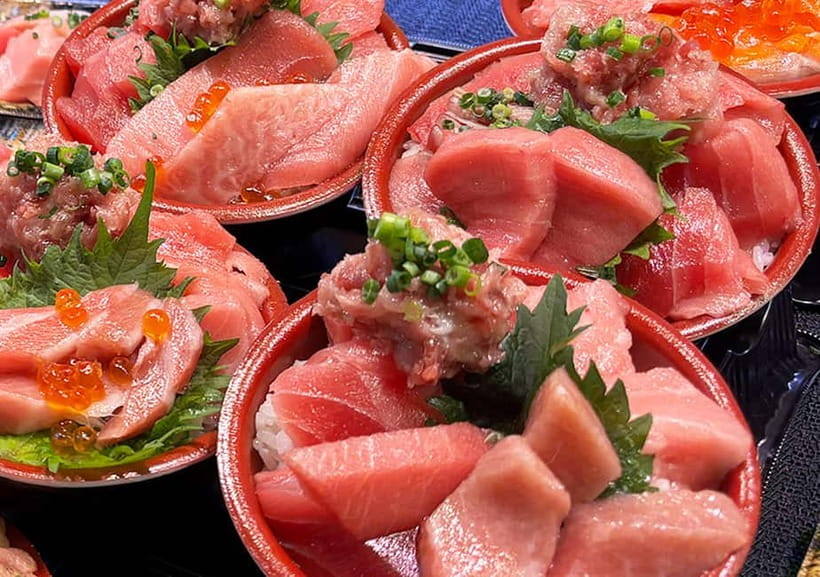
The fish-cutting show takes about 30 minutes and is the most distinctive planned part of the visit. A skilled chef fillets a whole fish using traditional techniques, then you can enjoy a fresh seafood bowl afterward.
This is more than a quick demonstration with a knife. It shows the care and precision involved in preparing seafood, and it gives you a clearer connection between the market stall and the food in your bowl. If you enjoy cooking, food traditions, or craft skills, this section should be a real highlight.
The seafood bowl is described as part of the experience, but meals are listed as not included. Plan to pay for food yourself rather than assuming the tour price covers every bite. That small point is important when comparing the $33.16 cost with the final amount you will spend.
The show also creates a fixed pause in the morning. That can be helpful after moving through crowded stalls, though it may feel slow if you mainly want to browse. The tour is not a free-form market wander. You follow a set route and stop when the group stops.
Seeing the working side of Tsukiji Fish Market
A separate 30-minute section takes you through Tsukiji Fish Market, where professional traders operate. This gives you a look at the market as a workplace, not just as a collection of snack stalls.
That distinction is valuable. The outer market is designed for food shopping and eating, while the working market offers a stronger sense of the trade behind Tokyo’s seafood culture. Your guide can explain what you are seeing and help you behave respectfully around people who are conducting business.
You should not expect a long, formal lecture on the seafood industry. The available details point to a practical walk with explanations along the way. The quality will depend on your guide’s speaking volume, timing, and ability to keep the group together.
This is where group size matters most. A maximum of 30 participants is not tiny, even if the tour is marketed as small-group. In a crowded market, you may stand at the edge of the group or miss part of an explanation. One person had trouble hearing a quiet guide, especially with surrounding noise. If clear narration is important to you, position yourself near the guide from the beginning.
More Fish Market Tours in Tokyo
- Tokyo Sushi Making Class in Tsukiji with Professional Chef
★ 5.0 · 1,177 reviews - Tsukiji Fish Market Guided Tour and Sushi Making with Pro Chef
★ 5.0 · 775 reviews - Tokyo: Tsukiji Fish Market Food and Culture Walking Tour
★ 4.7 · 757 reviews - Tsukiji Fish Market Small-Group Food Walking Tour
★ 5.0 · 621 reviews
How much value do you get for $33.16?
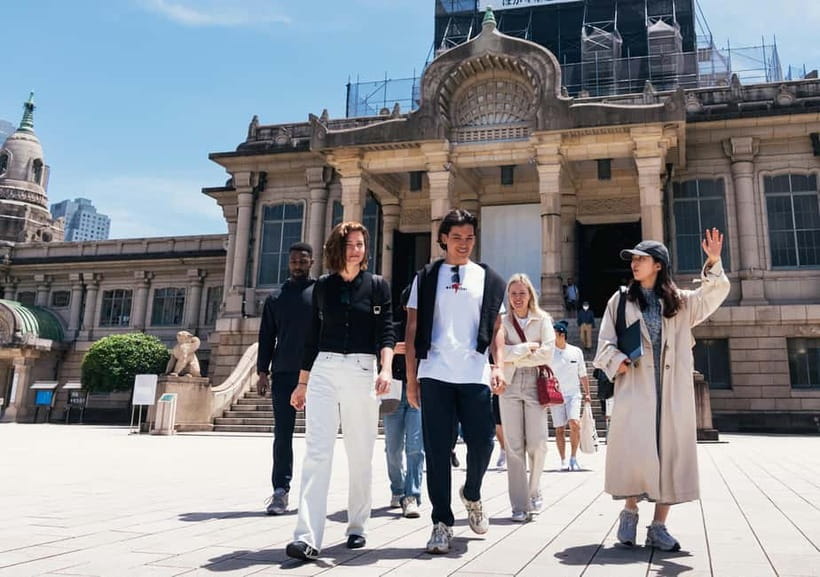
At $33.16 per person, the tour is priced as an affordable guided introduction rather than a full food tour with meals included. You are paying for local direction, cultural explanations, the fish-cutting show, and a structured route through a place that can be difficult to read on your own.
I think the price works best for a first visit to Tsukiji. You get a framework for understanding the market, and you can return later to explore favorite stalls at your own pace. A guide is especially useful if you do not recognize Japanese ingredients or feel unsure about ordering from a busy counter.
The value is weaker if you already know Tsukiji well or are comfortable choosing food independently. Some people felt they could simply walk through the market and spend the tour fee on food. That is a fair comparison. The tour does not provide a private guide, a long sit-down meal, or a detailed specialist lecture.
It is also worth counting the food budget. Since meals are not included, your total spending will be higher than the headline price. The tour makes sense when you want guidance and context, not merely a cheap way to eat breakfast.
The 99 percent recommendation rate and five-star score from 669 ratings suggest that the format works very well for most bookings. Still, the less positive experiences point to real issues: waiting around, a quiet guide, sun exposure, missed stalls, and poor group control. I would call this a good-value introduction, but not a guaranteed polished private experience.
Timing, comfort, and group management
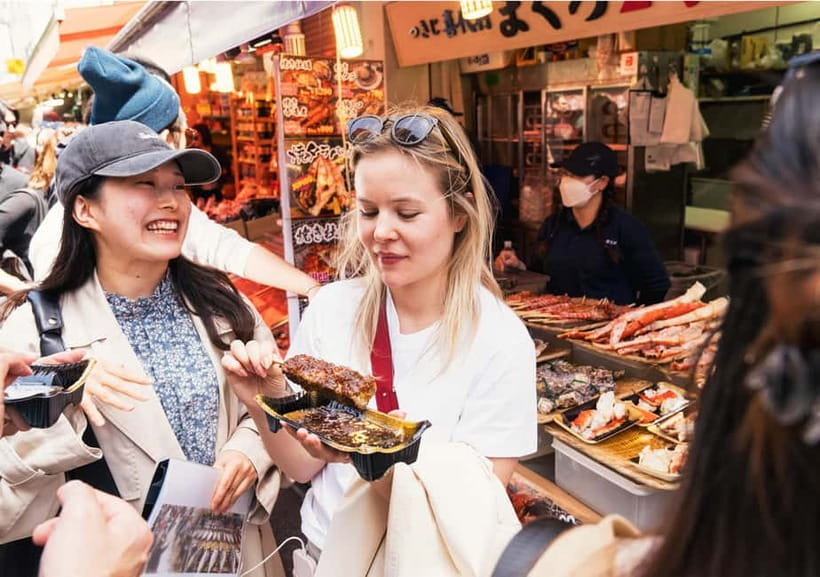
The activity lasts about two hours, which is long enough to cover the temple, food stalls, fish-cutting demonstration, and working market without taking your entire morning. The schedule is fairly full, so expect movement and short stops rather than a relaxed café-style outing.
Wear comfortable shoes. The route is a walking tour through market areas, and you may spend time standing while listening or waiting for food. The information says the tour is wheelchair and stroller accessible, which makes it a useful option for many families and visitors with mobility needs.
Accessibility does not remove every practical challenge. Crowds can make movement slower, and the market may have noisy sections where it is hard to hear. One person also reported that the guide continued making stops in direct sun after being told that sun exposure was a problem. If heat or sun is a concern, tell the guide clearly at the start and stay ready to speak up again.
The meeting point is close to public transportation, and the activity ends back at the same meeting point. That makes it easy to continue sightseeing in central Tokyo afterward without arranging a separate pickup.
The tour requires good weather. If poor weather causes cancellation, you are offered another date or a full refund. You can cancel for a full refund up to 24 hours before the start time, but changes made inside that 24-hour window are not accepted.
Which guide experience should you expect?
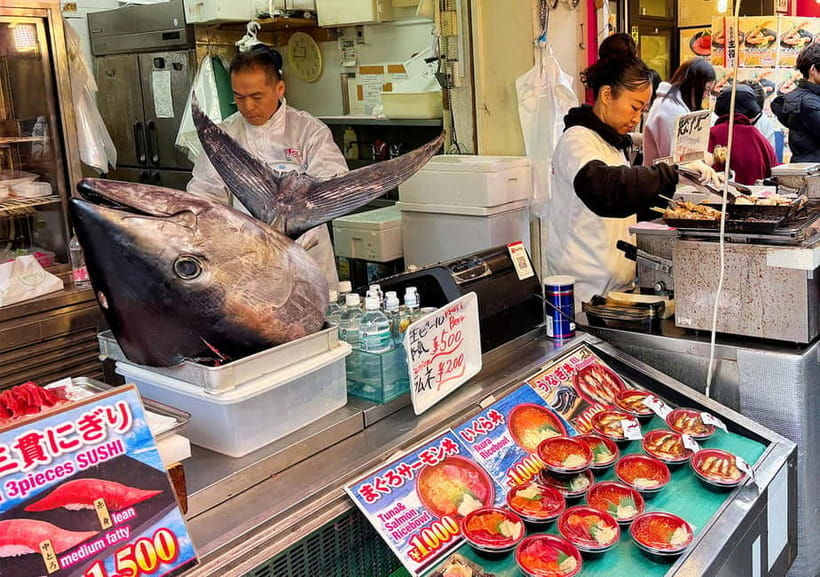
The guide makes a bigger difference here than on many ordinary sightseeing walks. Food stalls are easy to find. The hard part is knowing what to sample, explaining the ingredients, managing the group, and making yourself heard over the market noise.
George received praise for knowing where to take people and for helping them find food they enjoyed. Tomo was praised for clear English and for adding history and culture to the market visit. These examples show what the tour can be at its best: practical food advice combined with useful context.
The less successful experiences also offer a warning. A quiet guide can be almost impossible to follow in a crowded market. A guide who does not wait for the full group can make the route feel hurried and disorganized. If your guide is difficult to hear, move closer early rather than hoping the situation will improve.
The tour can also vary depending on the assigned guide. Do not book it expecting a particular person unless your confirmation specifically names that guide. The positive experiences with George and Tomo are encouraging, but they do not guarantee the same style on every departure.
Who will enjoy this Tsukiji walk?
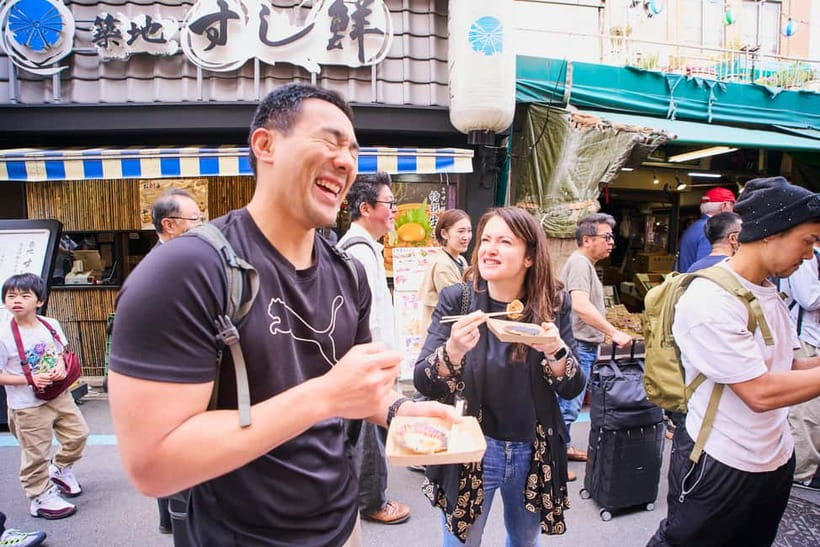
I would recommend it to first-time visitors who want help making sense of Japanese food and market customs. It suits people who enjoy tasting small portions, asking questions, and learning while walking.
It is also a good fit for families, since the route is wheelchair and stroller accessible. The two-hour length is manageable, and the fish-cutting show gives children something visual to focus on, though the market crowds may require close supervision.
Food lovers and home cooks should enjoy the traditional filleting demonstration. It offers a skill-based look at seafood preparation rather than only a series of tastings.
I would be more cautious if you dislike crowds, need a quiet environment, or prefer to explore without a schedule. You may also be disappointed if you expect a detailed temple tour or a full historical account of Tsukiji. The market is the main event.
My practical verdict on the Tsukiji experience
Book this tour if you want a guided first look at Tsukiji and plan to spend extra on food. The strongest reasons are the local food advice, the whole-fish cutting demonstration, and the chance to understand the working market instead of merely photographing it.
Skip it if you are comfortable exploring on your own and would rather put $33.16 toward food. Also think twice if a large group, waiting, or a guide who may be hard to hear would frustrate you.
For the best chance of a smooth morning, arrive at Tsukiji Hongwanji Temple early, stay near the guide, carry money for food, and keep your schedule flexible after the tour. I see this as a useful, reasonably priced introduction to Tsukiji, with excellent potential when the guide is clear and organized, but with enough crowd-related risks that it should not be sold as a perfectly personal food adventure.
FAQ
How long does the Tsukiji Fish Market tour last?
The tour lasts approximately two hours.
Where does the tour start?
It starts at Tsukiji Hongwanji Temple, 3-chōme-15-1 Tsukiji, Chuo City, Tokyo 104-0045, Japan.
Where does the tour end?
The activity ends back at the meeting point.
Is food included in the tour price?
Meals are not included. You should plan to pay separately for food from the market and any seafood you choose to eat.
Does the tour include a fish-cutting demonstration?
Yes. The tour includes a fish-cutting show in which a chef fillets a whole fish using traditional techniques.
Is the tour wheelchair and stroller accessible?
Yes. The activity is described as wheelchair and stroller accessible.
How large can the group be?
The activity allows a maximum of 30 participants.
Can I cancel for a full refund?
Yes. You can cancel at least 24 hours before the start time for a full refund. Changes or cancellations made less than 24 hours before the start time are not accepted for a refund.
More Street Food Market Tours in Japan
- Tokyo Food Tour Taste Fresh Delights at Tsukiji Market
★ 5.0 · 429 reviews - Toyosu Market Morning Tuna Auction and Tsukiji Food Tour with Licensed Guide
★ 4.5 · 146 reviews - Tokyo Tsukiji Fish Market Food Tour: 15 Stops & Walk Local Street
★ 5.0 · 139 reviews - Tsukiji Fish Market Private Food Tour in Tokyo
★ 5.0 · 18 reviews
More Market Walking Tours in Japan
- Tsukiji Fish Market: Street Food & Culture Walking Tour
★ 4.8 · 259 reviews - Tokyo: Guided Walking Tour of Tsukiji Market with Breakfast
★ 4.4 · 134 reviews - Tokyo: Tsukiji Market Walking Tour & Sushi Cooking Class
★ 4.6 · 122 reviews - Tokyo: Guided Walking Tour of Tsukiji Market with Lunch
★ 4.4 · 24 reviews
Just added around Tokyo
- Tokyo: Private Tsukiji Street Food & Sake with Local Guide★ 5.0 · 3 reviews
- Tokyo: Tsukiji Market Guided Tour & Sushi-Making Experience★ 4.4 · 11 reviews
- Tokyo: Tsukiji Market and Hama-rikyu Gardens Guided Tour★ 4.8 · 73 reviews
- Tokyo: Tsukiji Fish Market Culture Tour with Sashimi Tasting★ 4.6 · 54 reviews
- Tokyo’s Kitchen: Tsukiji Market Food & Culture Walk★ 4.7 · 74 reviews
- Tokyo: Tsukiji Fish Market Foodie and Educational Tour★ 5.0 · 4 reviews
- Tokyo : Tsukiji Fish Market Food Walking & Shrine Visit Tour★ 5.0 · 3 reviews
- Tokyo Morning Tour: Meiji Shrine, Asakusa & Fish Market★ 4.9 · 44 reviews
Street Food Market Tours, compared.
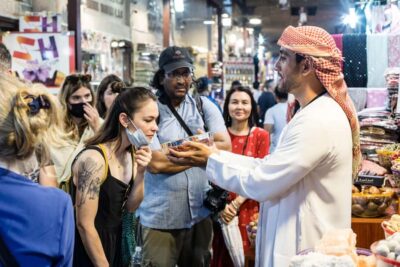
Old Town, Creek, Museums, Souks, & Street Food Tour
Read our review →
Old Town, Souks, Street Food, Guided Tour & Abra Ride
Read our review →

London Bridge & Borough Market Food Tour with 7 Authentic Dishes
Read our review →
Old Town, Souks, Street Food, Guided Tour & Abra Ride
Read our review →
Small Group Cooking Class & Market Food Tour in Florence
Read our review →
Browse the lists this tour appears in