
Review · THAILAND
Chiang Mai: Authentic Cooking Class with Market & Farm Visit
Come hungry, leave with Thai cooking skills. Grandma’s Home Cooking School combines a local market visit, a working organic farm, and hands-on cooking in a way that feels more personal than a standard restaurant lesson. You choose your dishes, cook at your own station, and sit down to eat what you have made.
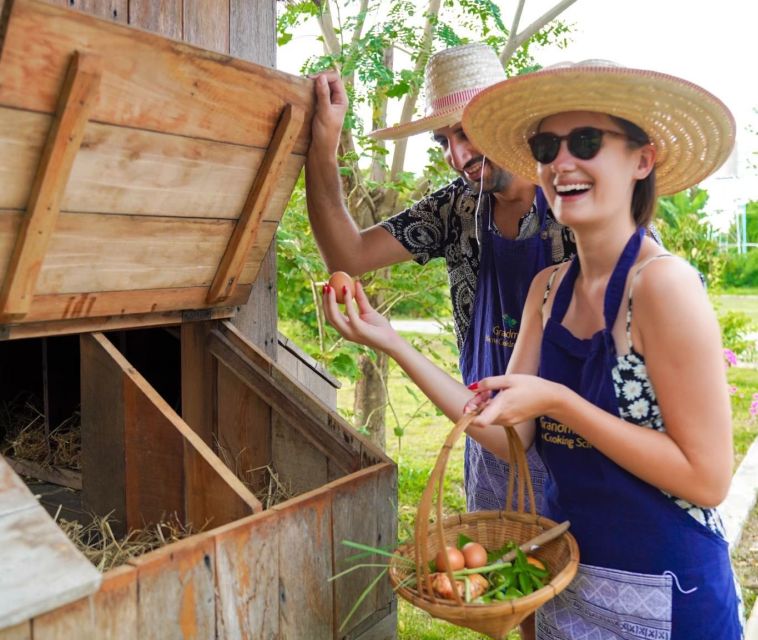
I especially like the farm-to-kitchen setting, where you can pick mushrooms, smell herbs, collect eggs, and meet the chickens. The second big strength is the teaching. Instructors such as Kiki, Jimmie, Patty, Roger, and Joyzaa are praised for clear explanations, humor, and patience. The main drawback is that the experience can feel busy and organized on a fairly large scale, and pickup details or van space may not always feel perfectly smooth.
Key points to know before booking
- Three experiences in one: Visit a local market, walk through an organic farm, then cook and eat a Thai meal.
- Your own cooking station: You prepare dishes yourself instead of simply watching a demonstration.
- Khao Soi is a highlight: Chiang Mai’s famous curry noodle soup is part of the menu and receives special praise.
- The full-day option adds coconut milk making: You use a traditional wooden coconut grater.
- Expect a generous amount of food: A light breakfast or early meal is wise, but do not arrive stuffed.
- Pickup is limited to five kilometers from central Chiang Mai: Hotels farther away may use a meeting point or pay a small extra fee.
From Chiang Mai hotel pickup to the countryside
The day begins with hotel pickup in an air-conditioned van. Free pickup and return are offered for hotels within five kilometers of Chiang Mai city center. You wait in your hotel lobby, with pickup commonly arranged around 3:30 PM to 4:00 PM for the afternoon or evening schedule, though you should confirm your exact time before the day.
Transport is one of the stronger parts of the experience. Drivers are generally on time, and the ride makes the move from central Chiang Mai to the farm simple. A few practical points matter, though. One booking had a little confusion over the pickup time, and another found the van somewhat snug. That does not cancel out the convenience, but you should keep your phone available and confirm the meeting instructions.
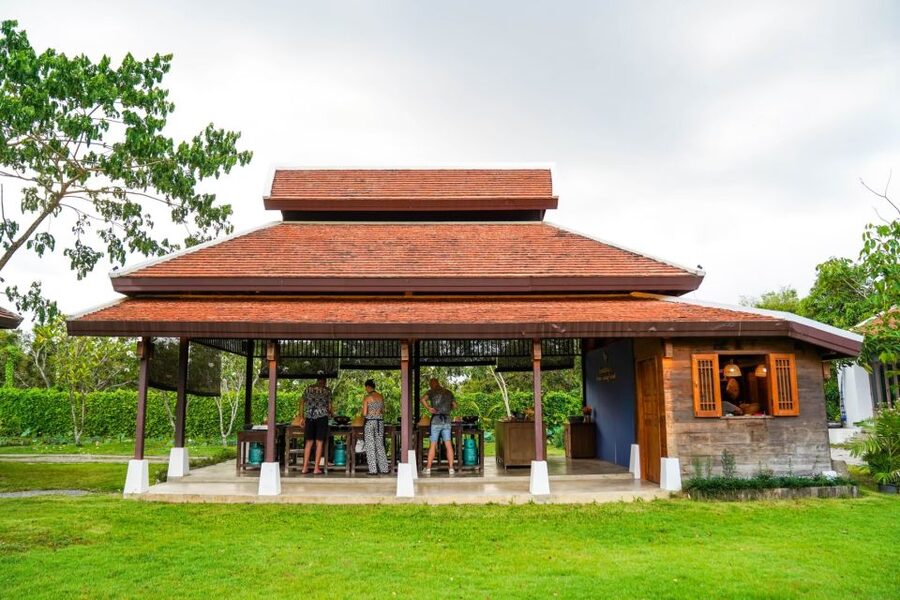
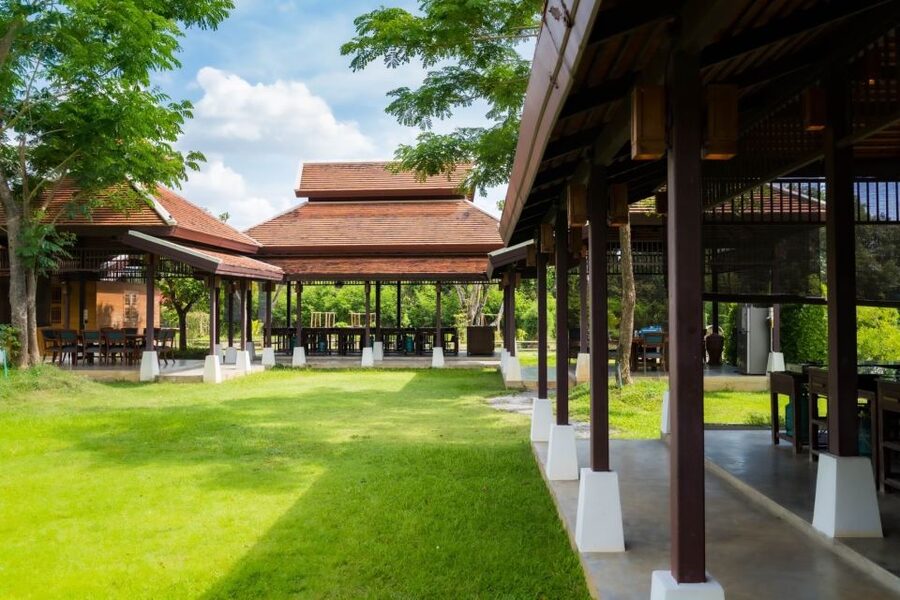
The cooking school is outside the dense center, surrounded by rice fields and open countryside. That change of scene is part of the appeal. You are not cooking in a cramped urban classroom. Instead, the setting gives the class room to breathe, with gardens, farm paths, outdoor kitchens, and evening light.
More Cooking Classes in Chiang Mai
- Chiang Mai: Cooking Class, Market & Thai Herbs Garden Tour
★ 4.9 · 4,824 reviews - Chiang Mai: Cooking Class with Market and Pickup
★ 4.9 · 1,365 reviews - Chiang Mai: Evening Cooking Class and Local Market Visit
★ 4.9 · 648 reviews
The local market turns ingredients into real food
Morning, afternoon, and full-day programs include a visit to a local market. Evening classes focus more on the farm and cooking, so check the option carefully if market shopping is important to you.
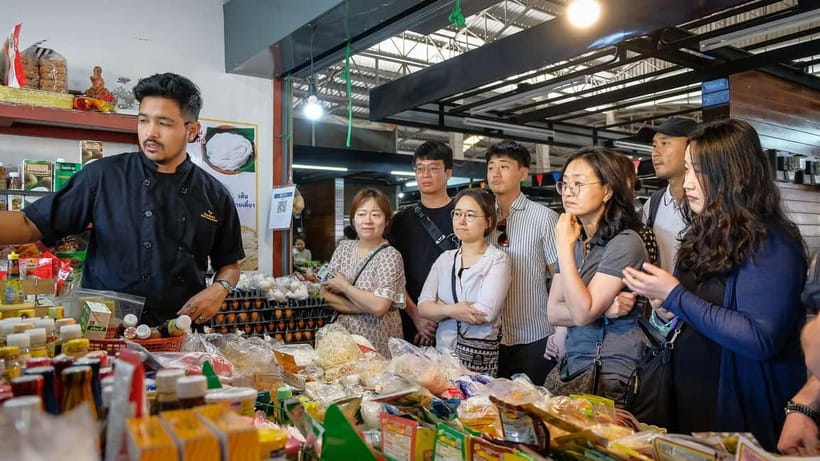
At the market, your English-speaking instructor introduces the ingredients used later in the class. This is not just a quick walk past stalls. You learn to recognize Thai herbs, vegetables, sauces, curry ingredients, and produce that can look unfamiliar when you first see it on a menu.
That early explanation changes how you read Thai food. Galangal, lemongrass, chilies, Thai basil, coconut, mushrooms, and curry spices stop being mysterious names. You begin to see how cooks build flavor from fresh herbs, aromatics, heat, sweetness, and salt.
The market is also useful after your holiday. You may not remember every Thai word, but you will have a better idea of what to look for when shopping or ordering food. If you are interested in food culture rather than just collecting another meal, this part earns its place.
The market can be lively and active, so comfortable shoes help. You also move on to the farm afterward, making the full route more active than a sit-down class.
Grandma’s organic farm brings the menu to life
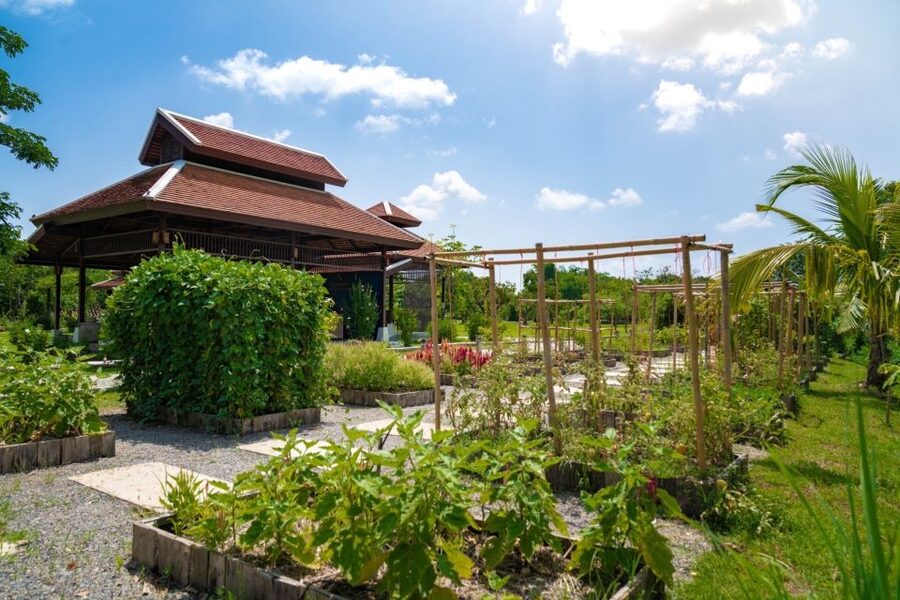
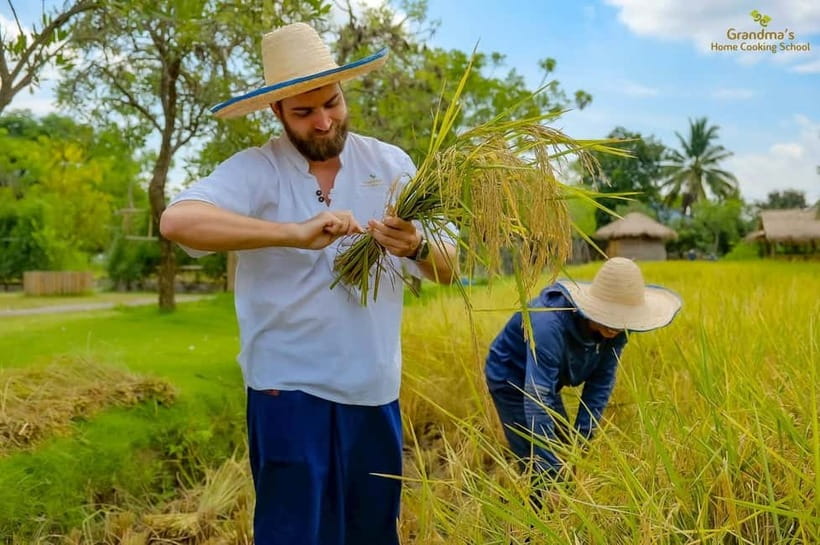
The farm is the most distinctive part of the experience. You walk through growing areas and learn where some of the ingredients come from before preparing them in the kitchen.
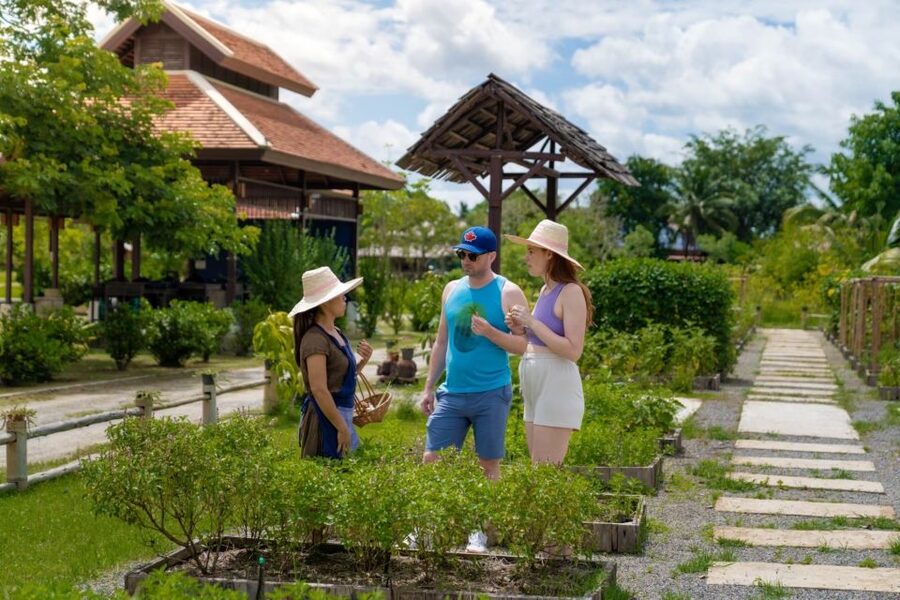
The exact vegetables ready for picking depend on the season and what is growing that day. Mushroom picking is a regular feature, with a mushroom hut that gives you a close look at a crop rarely explained in ordinary cooking classes. You also smell herbs and fruits, and your instructor explains how they are used in Thai dishes.
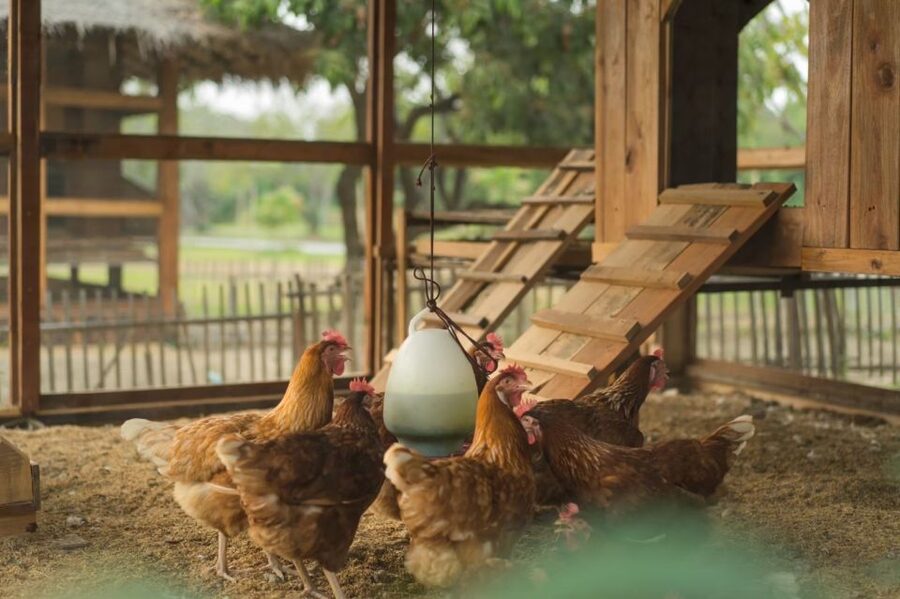
The chicken area adds a light, family-friendly touch. You can feed the chickens, collect fresh eggs, and even give them a gentle hug. This is not a staged animal show. It is a small farm activity that helps explain the everyday connection between fresh produce, eggs, and home cooking.
The gardens are also a pleasant break between the market and the kitchen. You can take photographs, enjoy the rice-field surroundings, and slow down before the practical work begins. Bring a sun hat and wear shoes that are comfortable for walking on farm paths.
One detail worth knowing: the animal activities are available, but vegetable picking depends on what is ready. If you are hoping to harvest a particular ingredient, keep your expectations flexible.
Your own station makes the cooking useful
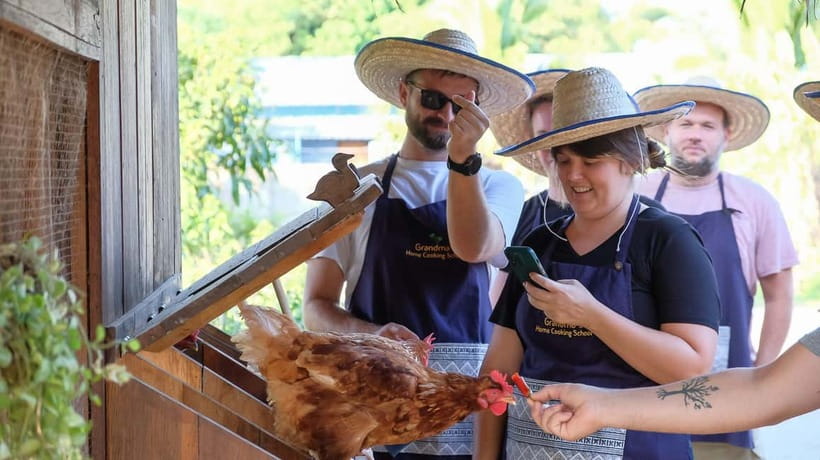
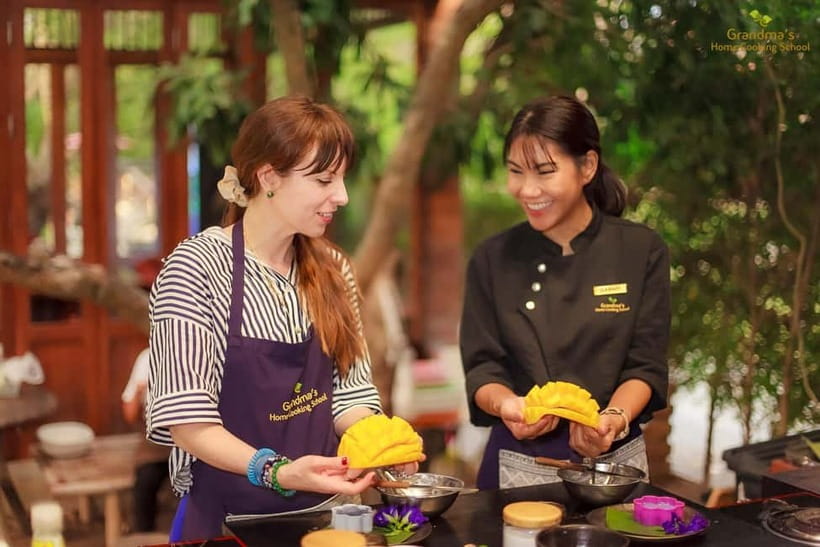
In the open-air kitchen, each participant has a personal cooking station. This is important. You are not standing at the back of a room trying to see a single demonstration. You chop, pound, stir, season, and adjust your own dishes with guidance close at hand.
The instructors lead you through each recipe step by step. No previous cooking experience is needed. You choose your menu at the beginning of the class, then prepare the selected dishes with the group.
Typical choices include:
- Pad Thai
- Pad Kra Prao
- Green curry
- Red curry
- Panang curry
- Tom Yum
- Tom Kha
- Som Tam
- Spring rolls
- Khao Soi
- Mango sticky rice
The exact combination depends on the class and your choices. Several half-day participants prepared three dishes, often a soup, Pad Thai, and a curry. Evening participants sometimes cooked four dishes, which explains why the meal can be surprisingly filling.
The most useful lesson is the curry paste. You make it from scratch with a mortar and pestle rather than opening a ready-made packet. That takes more effort, but it lets you understand how chilies, herbs, spices, and aromatics become a paste with real depth.
You can also adjust many recipes to your taste. If you prefer less heat, say so. If you like strong herbs or extra spice, the instructor can help you find the right balance. That flexibility makes the food more practical to recreate at home.
More Cooking Classes in Thailand
- Evening Cooking Class in Organic Farm with Local Market Tour
★ 5.0 · 394 reviews - Cooking Morning Class Chiang Mai Visit Organic Garden and Market
★ 5.0 · 211 reviews - Cooking Evening Class Chiang Mai Visit Organic Garden and Market
★ 5.0 · 187 reviews - Half-Day Cooking Class with Market Tour
★ 5.0 · 163 reviews
Khao Soi gives the class a Chiang Mai identity
Khao Soi is the signature dish to watch for. This northern Thai curry noodle soup combines noodles, curry, coconut, and a rich broth, usually with crisp noodles adding texture.
The class does more than present Khao Soi as a famous local dish. You learn how the components work together and why it tastes different from the Thai dishes many people already know from restaurants abroad.
Several participants considered the Khao Soi one of the best parts of the experience. If it is available in your selected menu, I would choose it, especially if this is your first visit to northern Thailand.
The recipe also gives you a useful taste of Chiang Mai’s food identity. Pad Thai is familiar around the world. Khao Soi feels more tied to the region, making it a better choice for a sense of place.
Mango sticky rice and the coconut-grater lesson
Mango sticky rice is served in the morning and afternoon classes. In the full-day and evening programs, it is taught as part of the cooking rather than simply placed on the table.
The dessert is a welcome finish because it balances the spicy and savory dishes. You work with sticky rice, coconut, and mango, learning how a few simple ingredients produce a dessert that is both rich and refreshing.
The full-day course adds traditional coconut milk preparation. You use a wooden coconut grater, an old-fashioned tool that makes the process more physical and memorable than pouring coconut milk from a carton.
This extra step is one reason to choose the full-day program if you want the most cultural detail. It also makes the day longer, with the full schedule lasting up to seven hours. That is a substantial block of time, so it suits people who enjoy cooking and do not need to rush to another activity.
Choosing between morning, afternoon, evening, and full day
The class options are similar but not identical.
Morning: This includes the market, farm activities, cooking, and mango sticky rice. It is a good choice if you want the rest of the day free. You will likely eat a full meal during the class, so plan your later meals accordingly.
Afternoon: This also includes the market and farm. The timing works well if you want a slower morning in Chiang Mai and a substantial activity later in the day.
Evening: This is a fine way to combine a cooking lesson with dinner. You may miss the market, but the farm and sunset setting can be especially appealing. One class began cooking as the light softened, which added atmosphere without taking anything away from the instruction.
Full day: This offers the most complete program, with market time, farm activities, more cooking, hands-on mango sticky rice, and coconut milk preparation. It is best for serious food fans, families with plenty of time, or anyone who wants the fullest farm-to-table experience.
The stated duration ranges from 210 minutes to seven hours. Read the selected option closely rather than assuming every class includes every activity.
The instructors make or break the mood
The teaching style is friendly, energetic, and often funny. Kiki is praised for combining cooking skill with warm instruction. Jimmie is known for high energy and jokes, while Patty brings a lively style that works well for families. Roger is described as clear and good with children, and Joyzaa receives praise for making the class entertaining.
That energy is usually an advantage, but humor is personal. One person found the jokes a little too frequent. If you prefer a quiet, technical cooking lesson, the cheerful group atmosphere may feel more animated than expected.
The English instruction is generally clear. You learn not only how to follow a recipe, but also what the ingredients do and why certain steps matter. The class is organized with assistants supplying ingredients and clearing used equipment, so you can focus on cooking rather than washing every bowl.
The school is not a tiny kitchen run by one grandmother. It has several kitchen areas and can handle multiple groups. That means the operation is polished and capable, but the experience is not entirely private or spontaneous. You still receive your own station and direct help, while sharing the wider farm with other groups.
Food, portions, and dietary needs
The portions are generous. You eat the dishes after making them, and several people found they had cooked more food than expected. I would keep breakfast or lunch light, depending on your class time.
Vegetarian and Halal options are available. Gluten-free meals, allergies, and other dietary needs can also be accommodated if you tell the school before the class begins. Specific care has been taken with gluten-free soy sauce, oyster sauce, and even gluten-free spring rolls.
Do not wait until the cooking starts to mention an allergy. Send the information ahead of time, then remind the instructor when you arrive. The ability to adapt the ingredients is a real strength, but good communication remains important.
Thai milk tea, Thai lemon tea, or butterfly pea flower tea is offered as a welcome drink. You also receive a herbal drink and unlimited drinking water during the class. Alcohol is not included, though it can be purchased.
What the $34 price delivers
At about $34 per person, this is strong value for a three-and-a-half-hour to seven-hour experience. The price includes hotel transport within the central pickup zone, a market visit on eligible schedules, the farm activities, instruction, your own station, drinks, the meal you cook, and a digital recipe book.
The value is not just the number of dishes. You also get the setting, transportation, ingredient education, and the chance to practice each recipe yourself. A basic restaurant meal would cost less, but it would not teach you how to make curry paste or identify Thai herbs at a market.
The full-day class costs more in time rather than simply adding another short lesson. You should choose it only if you want a full food-focused day. For most people, the morning, afternoon, or evening version provides enough cooking and food to feel satisfying.
A digital recipe book gives the class lasting value. Save it before leaving, since one person had trouble opening the recipe QR code afterward. It is a small issue, but checking the download while you still have help nearby is sensible.
Who will enjoy this Chiang Mai cooking class most?
You will get the most from this experience if you enjoy eating, cooking, gardens, and cultural explanation. It suits couples, families, solo participants, and small groups. Children under ten can join their parents, but they are treated as visitors and do not receive their own station unless booked at the adult price.
The class also works for people who usually feel unsure in the kitchen. The instructions are broken into manageable steps, and the staff keeps ingredients moving so you are not left guessing.
It may not suit you if you want a private lesson, a very quiet setting, or a short activity with no farm walking. The larger operation has several groups, and the popular instructors bring plenty of energy. Those are strengths for many people, but they are worth knowing in advance.
Bring comfortable shoes and a sun hat. Pets are not allowed.
Should you book Grandma’s Home Cooking School?
I would book this class if you want more than a recipe demonstration. The market helps you understand Thai ingredients, the farm gives the day a sense of place, and the cooking station lets you take real skills home.
Choose the evening option for a cooking lesson that also works as dinner. Choose the full day for coconut milk making, more time on the farm, and the broadest program. If you are short on time, the half-day classes still deliver plenty of food and instruction.
The main caution is to confirm pickup details, state dietary needs early, and accept that this is a well-run group school rather than a private home kitchen. For $34, the combination of transport, farm access, instruction, a large meal, and recipes makes it one of Chiang Mai’s better food activities.
FAQ
How long does the cooking class last?
The options range from 210 minutes to seven hours. The exact duration depends on whether you choose the morning, afternoon, evening, or full-day class.
Is hotel pickup included?
Yes. Free pickup and drop-off are available for hotels within five kilometers of Chiang Mai city center. Hotels farther away may use a nearby meeting point or require a small extra charge.
Does every class include a market visit?
No. Morning, afternoon, and full-day classes include the local market visit. The evening class focuses on the farm and cooking activities.
Can I request vegetarian, Halal, or gluten-free food?
Yes. Vegetarian and Halal options are available, and gluten-free meals or allergy adjustments can be arranged. Tell the school before the class begins.
Do children get their own cooking station?
Children under ten can join their parents but are considered visitors and do not receive their own station. You can book them at the adult price if you want them to have a separate station.
What should I bring?
Bring comfortable shoes for the farm walk and a sun hat. Alcohol is not included, and pets are not allowed.
More Farm Visits in Chiang Mai
- Morning Cooking Class in Organic Farm with Local Market Tour
★ 5.0 · 157 reviews - Chiang Mai: Half Day Cooking Class at Organic Farm
★ 4.8 · 96 reviews - Chiang Mai : Cook in Farm, Market tour & Go by a Local Train
★ 4.8 · 6 reviews - Full Day Thai Cooking Class in Organic Farm and Market
★ 5.0 · 3 reviews
Just added around Chiang Mai
- Chiang Mai: Half Day Morning Cooking Class with Market Tour★ 4.9 · 10 reviews
- Chiang Mai: Half Day Cooking Class at Organic Farm★ 4.8 · 96 reviews
- Full Day Thai Cooking Class in Organic Farm and Market★ 5.0 · 3 reviews
- Chiang Mai: Traditional Thai-Akha Cooking Class& Market Tour★ 5.0 · 25 reviews
- Chiang Mai: Morning Cooking Class with Market Visit★ 4.9 · 81 reviews
- Chiang Mai Light: Tuk Tuk Night Tour with Temples & Markets★ 5.0 · 7 reviews
- Chiang Mai: Half Day Evening Cooking Class with Market Tour★ 4.9 · 19 reviews
- Chiang Mai: Sticky Waterfall by Local Truck with Market Stop★ 4.8 · 26 reviews
Cooking Classes, compared.
Hanoi Cooking Class: Culture, Local Market & Meaning CSR Impact
Read our review →
5 Traditional Dishes Hanoi Cooking Class with Market Trip
Read our review →
Cooking Class and Lunch at a Tuscan Farmhouse with Local Market Tour from Florence
Read our review →
Cooking Class, Market & Thai Herbs Garden Tour
Read our review →
Paella Cooking Experience & Boqueria Market Tour
Read our review →
Cooking Class Hoi An:Local Market, Basket Boat, Fishing & Cooking
Read our review →
Hoi An Cooking Class(Market,BasketBoat Crabfishing&Cooking Class)
Read our review →
Phuket Thai Cooking Class with Market Tour Option
Read our review →Browse the lists this tour appears in