
Review · ITALY
Trajan’s Markets & Imperial Forums Private Tour with Special Pass & PhD Guide
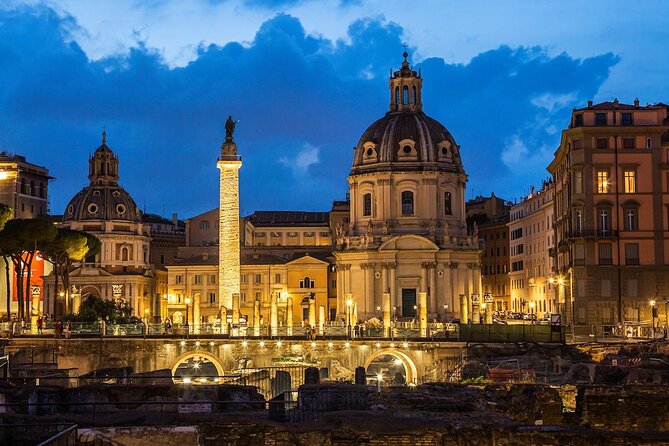
Rome’s marble still tells its own story. This 2.5-hour private tour brings you through Trajan’s Market and several Imperial Forums with a guide who holds a PhD, turning broken columns and worn stones into a clear account of Roman power. I like the small private setting and the pre-arranged Forum Pass, which keep the visit focused and reduce the usual ticket hassle.
I also like the route itself. It links Trajan’s Market, Trajan’s Column, Trajan’s Forum, the Forum of Nerva, and the Forum of Augustus in one compact morning. The main consideration is the price, $334.55 per person. That is a serious spend, especially for one short tour, so you should value expert interpretation and private attention rather than simply counting monuments.
Key points to know before booking
- A private group experience: Only your party takes part, so the guide can shape the explanation around your interests and questions.
- A PhD-level guide: The guide’s academic background adds depth, while past praise highlights a personable style that makes the subject feel alive.
- Five ancient sites in 150 minutes: You cover a lot of ground, with each stop receiving roughly 20 to 45 minutes.
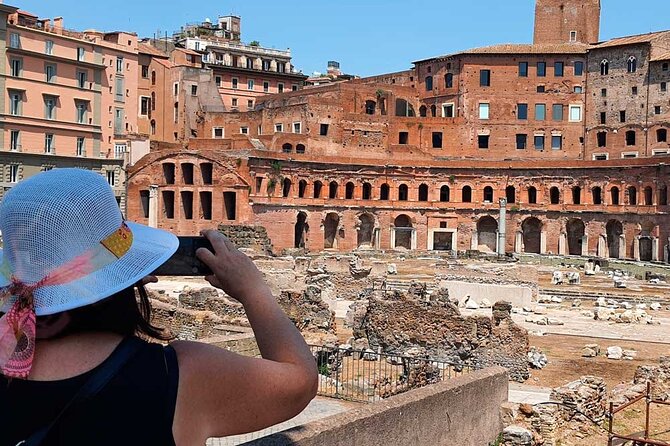
- Trajan’s Market is the main indoor visit: Its preserved shops, apartments, and covered market offer a useful look at Roman city planning.
- The Forum Pass is included: Entry is arranged in advance, which makes the morning easier to manage.
- A central route with a simple finish: You meet near public transportation on Via Quattro Novembre and finish along Via dei Fori Imperiali.
Why this short Rome tour works well
The Imperial Forums are often treated as a backdrop for the Colosseum. That is a mistake. These spaces explain how Rome’s emperors used architecture to display military success, political authority, and divine favor.
I like this experience because it gives those ruins a clear order. You begin with Trajan’s Market, then move through Trajan’s Column and Forum before reaching the smaller Forums of Nerva and Augustus. The route is not a random collection of old stones. Each stop adds another piece to the way Roman rulers shaped the city.
The tour starts at 9:30 a.m. and lasts about two hours and 30 minutes. That makes it useful for a short stay in Rome. You can spend the rest of the day elsewhere, perhaps visiting another major sight or simply finding lunch without sacrificing a full day.
The private format matters here. Imperial Forum ruins can be hard to read on your own. A column base may look like a pile of masonry until someone explains what once stood there, why it was built, and how it fitted into the larger complex. With only your group present, you can pause for questions instead of waiting for a large crowd to catch up.
More Private Market Tours in Italy
- Private Tour – Museum of the Imperial Forums in the Trajan Markets
★ 5.0 · 37 reviews - Rome: Private Cooking Class with Market Shopping Tour
★ 5.0 · 3 reviews - Market tour and Private Cooking Class in Rome with roman chef
★ 5.0 · 2 reviews
Trajan’s Market: Rome’s early urban shopping center
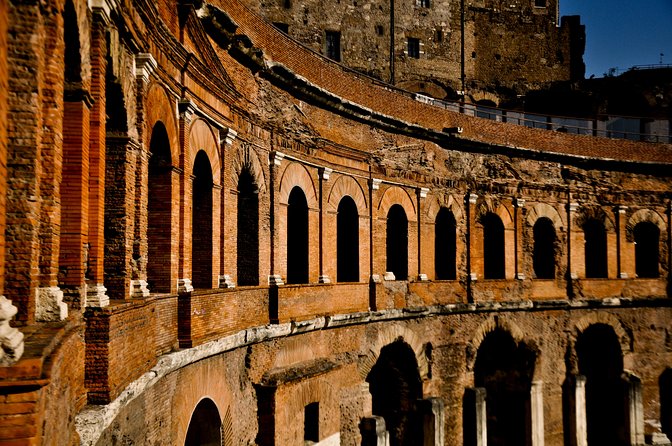
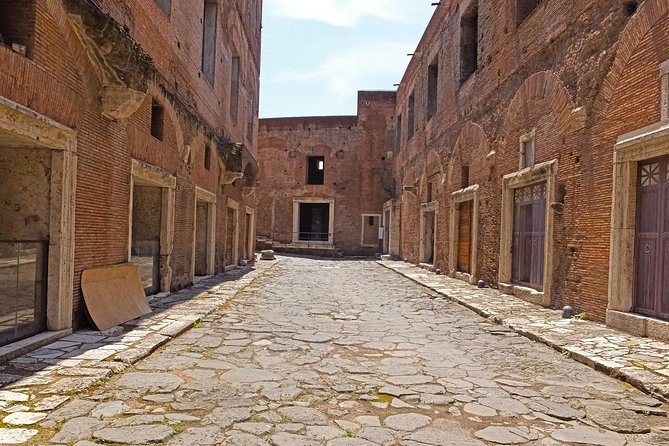
The first stop is Mercati di Traiano, the Museum of the Imperial Forums. You have about 45 minutes here, the longest portion of the tour, and that is sensible. Trajan’s Market is one of the best places on the route for seeing how Roman urban life worked beyond temples and triumphal monuments.
The complex included an undercover market, small shops, and apartments. It is often described as an early version of a modern shopping center, though you should not picture a Roman shopping mall with polished floors and bright signs. The comparison is useful because it points to the building’s practical purpose: commerce, movement, storage, and daily business were organized within a large architectural complex.
I find this stop valuable because it puts ordinary activity beside imperial ambition. The emperors commissioned grand forums, but cities also needed places where people could buy goods, conduct business, and live. The preserved remains give you a sense of Roman planning on a human scale.
The ruins are remarkably well preserved compared with many open-air remains in Rome. You can see how the structures fit into the slope and how different levels were used. Your guide can help you understand the spaces as a working part of the ancient city, not just as attractive ruins.
The museum setting also gives this stop a little protection from Rome’s weather and street noise. Still, the experience is archaeological rather than polished. You are looking at ancient masonry and partial structures, not complete rooms furnished as they once were. The guide’s explanation is a major part of the value.
Trajan’s Column and its 29-meter story
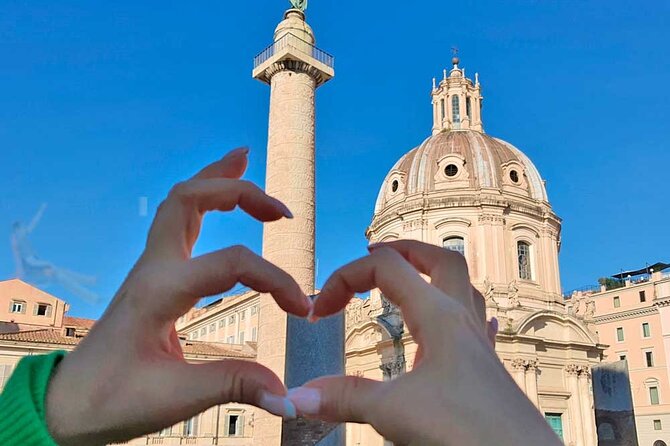
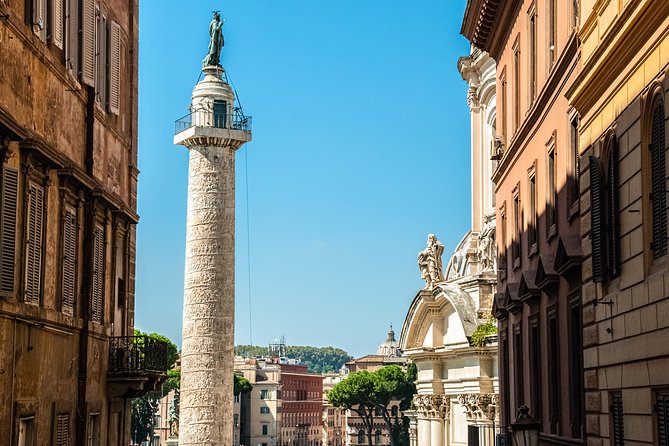
Next comes Trajan’s Column, a 29-meter monument made from Carrara marble. It was built to honor Emperor Trajan’s victory over the Dacians, whose territory corresponds largely to present-day Romania.
The column’s most striking feature is the spiral frieze winding around its shaft. It presents scenes from the military campaigns, with soldiers, commanders, fortifications, and episodes from the conflict carved into the marble. From ground level, the details are difficult to see. Your guide’s help is particularly useful here, since the monument can otherwise become a quick photo stop.
You receive about 20 minutes at the column. That is enough for a focused explanation, but not enough to inspect every scene in the frieze. I would listen for the broad story and the guide’s choice of key events rather than expect a complete reading of the entire spiral.
The column is also a lesson in imperial messaging. Trajan was not simply commemorating a war. He was presenting victory as a public achievement worthy of a permanent monument. The scale, material, and carved narrative all served that purpose.
This is one of the places where a strong guide makes a clear difference. The guide praised in the supplied feedback was described as personable and able to turn expert material into a living history lesson. No guide’s name is provided, but that description gives you a useful expectation: the experience aims for explanation and storytelling, not a dry list of dates.
Trajan’s Forum and the scale of imperial power
From the column, you continue to the Forum of Trajan. This was the last and largest of Rome’s Imperial Forums, and it served as a public and political center within the Roman capital.
The original complex included an enormous basilica, two libraries, markets, and a large temple. Much of what you see now is fragmentary, but the scale still comes through. The open space, surviving foundations, and scattered architectural pieces suggest an ambitious project designed to make the emperor’s power visible to the people who entered it.
You spend about 20 minutes here. That is a brisk visit, but it follows naturally from the column. The column tells the story of military victory, while the forum shows how that victory could be turned into architecture, administration, and civic display.
I like this pairing. It prevents Trajan’s Column from becoming an isolated monument. You see it as part of a much larger setting, one that linked military success with public works.
The drawback is that the ruins require imagination. You will not see the complete basilica or libraries as functioning buildings. The tour can explain what once occupied the space, but the remaining stones do not provide every answer on their own. If you enjoy archaeology, this partial quality may be part of the appeal. If you prefer fully restored interiors, this stop may feel spare.
Same place, a different set of stalls:
- Rome: Colosseum, Roman Forum & Trajan’s Market Exterior Tour
★ 4.3 · 2,038 reviews - Taste of Testaccio: Special 15 Year Anniversary Edition
★ 5.0 · 1,658 reviews - Roman Food Tour with Visit to the Trionfale Food Market
★ 5.0 · 471 reviews - Authentic Roman Cooking Class & Market Experience
★ 5.0 · 363 reviews
Forum of Nerva and the narrow passage of power
The Forum of Nerva is smaller and more confined than Trajan’s Forum. It was the fourth Imperial Forum to be built and was planned under Emperor Domitian, then completed by his successor Nerva in AD 97.
The forum occupied a narrow space lined with colonnades. The Temple of Minerva is an important surviving feature, and only two of the roughly 50 original columns remain standing. You have around 20 minutes here.
This stop is a good reminder that Roman monuments did not all follow the same pattern. Trajan’s complex aimed for enormous scale. Nerva’s forum had to fit into a tight space between earlier buildings, which shaped its long, narrow form.
The small number of surviving columns can be deceptive. Two columns may not sound like much, but they help you picture the repeating colonnade that once lined the area. Your guide can also explain the political timing behind the construction. The project began under one emperor and took the name of another, an arrangement that reflects the succession of Roman rulers and their desire to claim a place in the city.
For me, this is a quieter stop than Trajan’s Market or Trajan’s Forum. Its value comes from comparison. After seeing the large imperial complexes, you can notice how space, design, and political circumstances changed from one forum to the next.
Forum of Augustus and the Temple of Mars Ultor
The final stop is the Forum of Augustus, also scheduled for about 20 minutes. It was built by Octavian Augustus, Rome’s first emperor, and included the Temple of Mars Ultor, or Mars the Avenger.
The remains today include the high podium and front steps of the temple, several column bases, and three impressive Corinthian columns of white marble. These fragments give the site a strong visual focus. You can see where the temple rose above the surrounding forum and how its elevated position helped command attention.
Augustus used architecture to establish his authority and connect his rule with Rome’s past, military purpose, and religious tradition. The Temple of Mars Ultor had a clear symbolic role, and the surviving remains make that message easier to understand than a bare list of dates would.
This final stop works well as the end of the route because it lets you compare Augustus’s forum with the later projects of Nerva and Trajan. Rome’s emperors were not building in an empty field. Each new forum had to fit into an already crowded center, while also making a claim about the ruler who ordered it.
The visit ends on Via dei Fori Imperiali. That central location is practical if you want to continue sightseeing on foot. The tour does not include private transportation, snacks, or soft drinks, so plan to handle those separately.
What the private format adds
A private tour is not automatically better. It is better when the subject benefits from questions, context, and a flexible pace. The Imperial Forums fit that description.
Only your group participates, so you do not have to adapt to a large crowd. If you want more detail about Roman building methods, political succession, or the Dacian wars, you can ask. If your group has children or mixed interests, the guide may be able to adjust the explanation, though the exact flexibility is not specified.
The licensed guide is included, and the academic background is one of the main reasons to consider the experience. The strongest praise focuses on the guide’s ability to make expert material engaging and personal. That matters in an archaeological area where the physical remains can be difficult to interpret without help.
The route is also efficient. Five stops in 150 minutes means you will keep moving, but you will not spend the morning standing in a ticket line or trying to decide what each ruin means. The Forum Pass is included, and entry is arranged ahead of time.
Price, pace, and who gets the best value
At $334.55 per person, this is a premium experience. The price makes the most sense for someone who places a high value on a private guide with advanced academic training, a planned route, and included admission.
It is less convincing if your main goal is simply to see the ruins quickly. Much of the Imperial Forums can be viewed from public areas, and a visitor who enjoys reading signs or exploring independently may prefer to spend less and take more time.
I would consider this tour a good fit for:
- A first-time visitor with limited time in Rome
- A history enthusiast who wants serious context
- A couple or small group seeking private attention
- Anyone who finds ancient ruins difficult to interpret alone
- Visitors who prefer a fixed morning plan with entry arranged
I would think twice if you want a slow archaeological study. The 20-minute visits are enough for orientation and explanation, but not for lingering over every architectural detail. The non-refundable booking policy also means you should be certain about your schedule before paying.
The tour is booked, on average, about 95 days ahead. That suggests planning early is sensible, especially if you need a particular date. Confirmation arrives at booking, and the meeting point is near public transportation on Via Quattro Novembre.
Practical details for the morning
You meet at Via Quattro Novembre, 94, in Rome at 9:30 a.m. The meeting point is described as easy to reach by public transportation, which helps because private transport is not part of the experience.
Wear comfortable shoes. Even a short route through ancient sites can involve uneven archaeological surfaces and a fair amount of standing. The exact surface conditions and accessibility details are not provided, so anyone with specific mobility needs should confirm before booking.
Service animals are allowed, and most people can participate. The tour ends on Via dei Fori Imperiali rather than returning to the starting point, so note the one-way arrangement when planning the next part of your day.
Bring water and any snack you may want. Food and soda are not included. The tour itself is tightly timed, so a small drink is more practical than expecting to stop for refreshments along the way.
Should you book this Imperial Forums tour?
Book it if you want the ancient center of Rome explained by a highly trained guide, and if a private setting is worth paying for. The strongest feature is not simply the number of ruins. It is the way the route connects markets, military victory, temples, and imperial power in one manageable morning.
Skip it if you are satisfied with a self-guided look at the forums or if $334.55 per person feels too high for two and a half hours. The remains are partial, and the schedule moves quickly.
For a short Rome visit, a history-focused couple, or a small group that wants expert attention, this is a strong choice. Just book only when your plans are firm, arrive ready to walk, and expect the guide’s explanations to carry as much weight as the stones.
FAQ
How long does the tour last?
The tour lasts approximately two hours and 30 minutes.
What time does the tour begin?
The tour starts at 9:30 a.m.
Where does the tour meet?
The meeting point is Via Quattro Novembre, 94, 00187 Rome, Italy.
Where does the tour end?
The tour ends on Via dei Fori Imperiali in Rome.
Is the tour private?
Yes. Only your group participates in the activity.
Is admission included?
Yes. A Forum Pass and admission to the listed sites are included.
More Private Market Tours in Rome
- Cairo 8 Hour Private Tour of Pyramids, Egyptian Museum and Bazaar
★ 5.0 · 2,931 reviews - Private Excursion to Maeklong Railway and Floating Markets
★ 5.0 · 850 reviews - Floating and Railway Market (Optional Waterfall): Private Tour
★ 5.0 · 827 reviews - Cairo: Private Pyramids, Museum & Bazaar Tour with Lunch
★ 4.6 · 744 reviews
Just added around Rome
- Testaccio Experience: Street Food, Market and Traditions★ 5.0 · 4 reviews
- Rome: Testaccio Food & Market Tour with Pasta & Wine★ 5.0 · 38 reviews
- Rome: The Vatican Market Experience Tasting and Class★ 4.7 · 10 reviews
- Rome: Taste of Testaccio Food & Market Tour★ 4.9 · 38 reviews
- Rome: Temples, Squares & Markets Guided Walking Tour★ 4.8 · 26 reviews
- Rome: Trajan’s Markets & Museum of The Imperial Fora Tour★ 4.8 · 4 reviews
- Farmers Market Shopping and Roman Full Course Class – SHARED★ 5.0 · 12 reviews
- Rome: Prati Food & Wine Market Tour with St. Peter Square★ 5.0 · 7 reviews
Private Market Tours, compared.
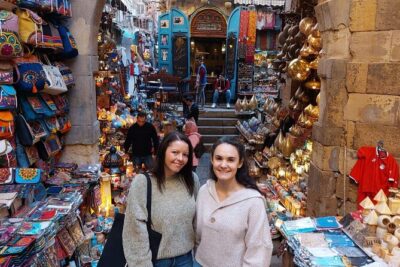
Cairo 8 Hour Private Tour of Pyramids, Egyptian Museum and Bazaar
Read our review →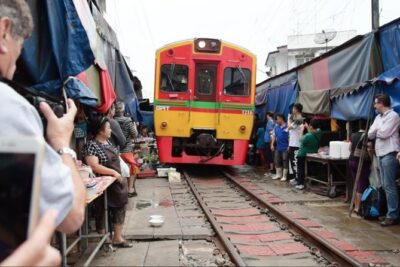
Private Excursion to Maeklong Railway and Floating Markets
Read our review →
Floating and Railway Market (Optional Waterfall): Private Tour
Read our review →
Shopping in the Souks of Marrakech Private Tour
Read our review →
Local Markets & Khan el Khalili Private Shopping Tour
Read our review →
Private Excursion to Floating Market and Ayutthaya World Heritage
Read our review →
Private Heritage Walking Tour in Jaisalmer Fort and Old Bazaar
Read our review →Browse the lists this tour appears in