
Review · GREECE
Private Athens Walk: Ruins, Markets & Local Stories
Athens makes sense when you walk its layers. This three-hour private tour links working markets, old neighborhoods, Roman remains, flea stalls, and Acropolis views in one useful morning. I like the way it moves from ordinary city life to major archaeological sights, rather than treating Athens as a string of monuments. I also like the private format, which gives you room to ask questions and adjust the pace.
The main drawback is that the tour does not enter the Acropolis. It finishes near the entrance, so you must buy a separate ticket and visit on your own. Three hours is enough for a strong introduction, but not enough for a slow market visit, a full archaeological tour, and much time inside the monuments.
Key points to know before booking
- Start at 9:30 a.m. in Kotzia Square: You begin near central Athens streets, the Mayor’s Office, and the city’s food markets.
- The route connects modern life with ancient Athens: You move from produce stalls and local shops to Hadrian’s Library, the Ancient Agora, and Acropolis views.
- It is genuinely private: Only your group participates, which makes conversation and questions easier.
- Market purchases and monument entries cost extra: Bring money if you want food, souvenirs, or admission to archaeological sites.
- Coffee and a local sweet are part of the experience: The stop in or around Plaka adds a welcome pause after several hours on foot.
- Guide quality is a major strength: Babis and George received especially warm praise for their enthusiasm, English, local insight, and ability to explain architecture and Greek culture.
Starting among Athenians at Kotzia Square
Meet your guide at Kotzia Square, at Sofokleous 18, at 9:30 a.m. This is a practical starting point because you are already in central Athens, close to public transportation and within reach of the city’s main historic districts.
The first minutes set the tone. Rather than beginning at a polished monument, you head toward Athinas Street and the neo-classical Mayor of Athens building. Shops and food businesses are getting ready for the day, and your guide explains how trade and daily commerce have shaped this part of Athens for centuries.
That is a useful introduction. You see the city as a place where people work, shop, argue, eat, and commute, not just as an outdoor museum. If this is your first morning in Athens, the route helps you understand how the central districts fit together.
The start is also a reminder to wear good shoes. The walk covers several neighborhoods, and the pavement can be uneven in older streets. You will want comfortable footwear more than stylish footwear here.
More Private Market Tours in Athens:
- Cairo 8 Hour Private Tour of Pyramids, Egyptian Museum and Bazaar
★ 5.0 · 2,931 reviews - Private Excursion to Maeklong Railway and Floating Markets
★ 5.0 · 850 reviews - Floating and Railway Market (Optional Waterfall): Private Tour
★ 5.0 · 827 reviews
Central Market: the best look at daily Athens
The Central Market is one of the most worthwhile parts of the walk. You pass stalls selling fruit, vegetables, meat, cheese, herbs, nuts, and other food used in Greek cooking. Your guide points out local favorites and explains what you are seeing, which is far more useful than wandering through the aisles without context.
The market gives the tour its strongest connection to present-day Athens. Ancient Athens traded food and goods in public spaces, and modern Athens still depends on markets where people buy what they will cook that day. The link between old and new feels natural rather than forced.
You can purchase fresh produce or other items, but those costs are not included. The tour information also says additional food and drinks are extra, so bring some cash or a payment card if you want to taste something along the way.
The market takes about 30 minutes. That is enough to get a good sense of the place, though not enough for a long food stop. If you love markets, you may want to return later and explore at your own pace.
Monastiraki and the city’s overlapping eras
From the market, you continue toward Monastiraki Square. This is one of Athens’ most recognizable public spaces, with shops, food businesses, old religious buildings, and archaeological remains packed close together.
The name Monastiraki comes from the Greek word for monastery. The Pantanassa Monastery sits in the square, a small but important reminder that this area is not simply a shopping district. Your guide helps separate the layers, so you can notice the older structures amid the modern traffic and commercial activity.
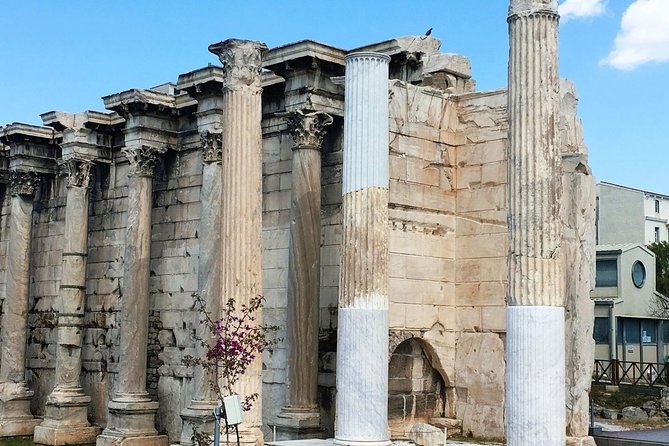
Next comes Hadrian’s Library, built in the first century. Even from outside, it is an important stop because it shows how Roman Athens invested in public buildings and learning. You also pass the Tzistarakis Mosque, built in the 18th century and now used as a ceramics museum.
These stops are brief, about five minutes each in the stated schedule. That means you should expect an explanation and an exterior look, not a detailed museum visit. If you want to go inside Hadrian’s Library or the ceramics museum, you will need separate time and admission.
The strength here is the sequence. A monastery, a Roman library, an Ottoman-era mosque, and a modern public square all appear within a short walk. Athens rewards this kind of close attention.
Avysinias Square and the Monastiraki shopping lanes
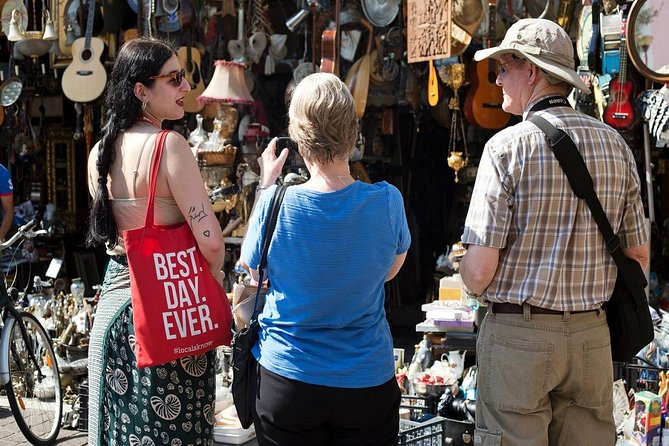
The walk continues through the flea market around Avysinias Square, then along Ifaistou or Pandrossos. The exact lane may vary, but the character is similar: small shops selling leather sandals, handmade icons, musical instruments, antiques, and other Greek specialties.
This is a good place to shop with guidance. Your guide can help explain what is locally made, what makes a sensible souvenir, and which items suit your interests. You are not simply dropped into a wall of shops and left to guess.
The market is also a place to keep your expectations sensible. It is a shopping area, not a quiet archaeological quarter. Prices and quality vary, so take your time before buying. The tour allows about 30 minutes, enough for a quick look and perhaps a purchase, but not a long browse through every stall.
I particularly like this part for first-time visitors. A guide can point out side streets you might otherwise skip, and the market provides a welcome change from formal sightseeing. You get a more useful sense of how Athens sells itself, both to local shoppers and to people looking for a keepsake.
A few more market tours around Athens worth a look
- Athens: Classic Cooking Class with Market Visit and Wine
★ 5.0 · 1,101 reviews - Athens: Food Market Visit and Cooking Class with Wine
★ 4.9 · 1,087 reviews - Athens, Greek food tour including market visit
★ 5.0 · 618 reviews - Athens Market Tour and Cooking Class in a Beautiful Garden
★ 5.0 · 122 reviews
The Ancient Agora and views toward the Acropolis

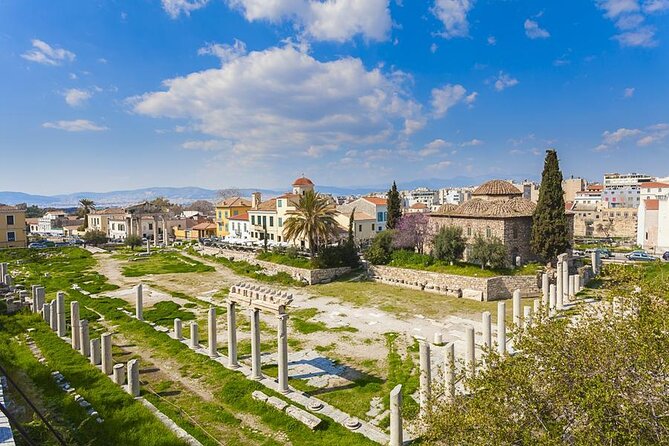
The route then passes the Ancient Agora, the civic and commercial center of ancient Athens. Merchants traded here during Greek and Roman times, and public life unfolded around this space.
The schedule allows roughly 15 minutes near the Agora. That is enough for an outside explanation and a look at the setting, but it is not a full visit to the archaeological site. Admission is not included. If the Agora matters greatly to you, plan a separate visit when you can take more time.
From Thission, you get views toward the Acropolis. This is one of the tour’s best moments because the hill appears in relation to the city around it. Your guide can help you identify the monuments and explain how the Acropolis fits into Athens’ long development.
The tour is especially useful for people who like history and architecture but do not want three straight hours of dates and names. The route keeps changing: market, square, mosque, flea stalls, ancient civic center, and hilltop monuments. That variety helps the information stick.
Plaka, coffee, and a slower conversation
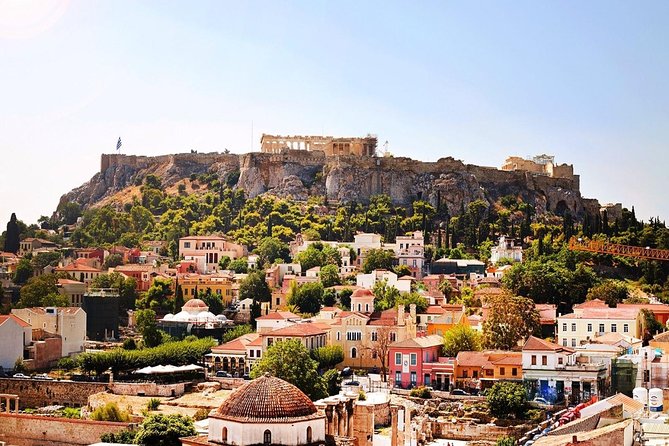
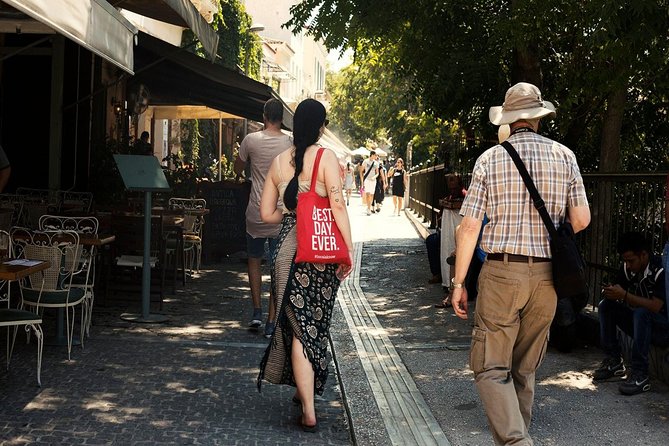
The final neighborhood section leads through Thission and toward Plaka, one of Athens’ oldest districts. Along the way, you pass houses dating from the 17th and 18th centuries. These streets offer a different mood from Athinas Street and Monastiraki, with more emphasis on older residential architecture and small lanes.
The itinerary includes about an hour around Plaka, including a freshly brewed coffee or soft drink and a local sweet. The food and drink details deserve a quick check when booking because extra food and drinks are listed as excluded, but the experience clearly includes a planned refreshment stop.
This pause is more than a snack break. It gives you time to ask about Greek customs, local neighborhoods, restaurants, bars, and what to do during the rest of your stay. Several past outings with guides such as Babis and George were praised for this conversational style. One especially memorable variation included a rooftop café with a view of the Acropolis.
Do not assume a rooftop stop is guaranteed, since the stated route only promises coffee or a soft drink and sweet. Still, the pause is valuable. After several hours on foot, sitting down with a local guide can turn a list of sights into practical advice for the rest of your visit.
Finishing at the Acropolis entrance

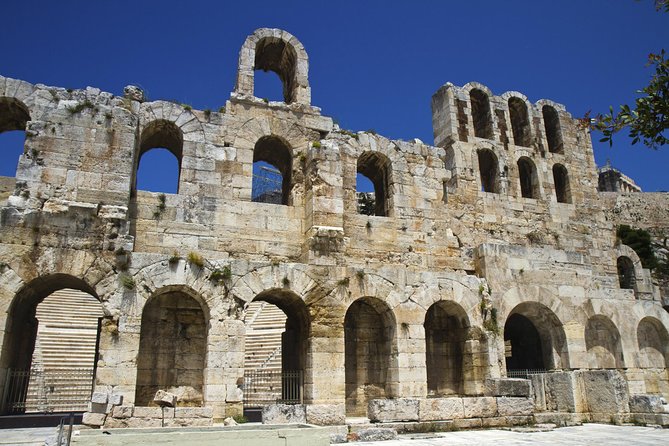
The walk concludes at the entrance to the Acropolis. Your guide can offer advice about continuing independently or getting back to your hotel, but the tour does not take you inside.
This arrangement has both advantages and limits. You finish in a useful location and can continue straight into your Acropolis visit if you have already arranged a separate ticket. On the other hand, you need to plan that visit carefully. The private walk does not include Acropolis admission, and the guide’s explanations around the perimeter are not a substitute for seeing the monuments from inside.
If you want to enter afterward, allow enough time and make sure your ticket arrangements match your schedule. The tour itself begins in central Athens and ends near the Acropolis, so it works well as a morning orientation before an independent afternoon visit.
What the private format adds
The private setup is the main reason to consider the price. At $166.64 per person, this is not a cheap introductory walk, especially for a solo visitor. But only your group participates, so you are not sharing the guide with a large crowd.
That matters in a market. You can stop to ask about ingredients, traditions, or a shop without waiting for a group to gather. It also helps families and mixed-age groups, since the guide can explain complicated subjects in a way that suits the people in front of them.
The private format may also make the walking pace more comfortable. One family with adults and very young children found the experience manageable, and the tour allows time for a coffee stop. Still, this is an active walking tour, not a sightseeing ride. Children must be accompanied by an adult, and everyone should be ready for several hours on foot.
The price makes the most sense for a couple, family, or small group that values personal attention and wants to use the guide as a source of local advice. It is harder to justify if you mainly want monument admission or a quick checklist of sights.
Guides who bring the city to life
Guide quality can shape this tour more than the route itself. Babis is repeatedly praised for his English, warmth, passion for Athens, and ability to explain architecture, archaeology, and Greek culture. George also received praise, including for creating a relaxed, friendly atmosphere and finding a café with an Acropolis view.
You should not assume a particular guide will lead your booking unless the provider confirms it. But the repeated strengths are clear: the best version of this experience depends on a guide who can connect dates and buildings with ordinary Greek life.
That connection is what turns the tour from simple sightseeing into orientation. You learn where the districts are, how they relate to each other, and what to return to later. One useful result is that you can spend the rest of your stay moving around Athens with a much better sense of direction.
Practical details that affect your choice
The tour uses a mobile ticket and requires advance confirmation. It begins at Kotzia Square and ends at the Acropolis, with public transportation available near the starting area.
Service animals are allowed, and most people can participate. The supplied details do not promise a fully step-free route, so anyone with mobility concerns should ask the provider about current street conditions and the exact path before booking.
The tour has free cancellation up to 24 hours before the start time. Cancellations or changes made less than 24 hours beforehand are not accepted for a refund. Since the experience is private, confirm the group details and meeting instructions before the cancellation deadline.
Who should book this Athens walk?
I would choose this tour if you have limited time in Athens, want a local introduction, or enjoy mixing food markets with archaeology. It is particularly good for first-time visitors, history and architecture fans, families wanting a private pace, and anyone who prefers conversation to a large guided group.
I would look elsewhere if your main goal is a detailed visit inside the Acropolis, Ancient Agora, or Hadrian’s Library. This route shows you the setting and explains the monuments, but it does not replace site admission or a specialist archaeological tour.
Book it early in your Athens stay if you can. The route gives you practical bearings, shopping ideas, neighborhood names, and suggestions for bars and restaurants. Then you can return to the places that caught your attention.
FAQ
How long is the Private Athens Walk?
The experience lasts approximately three hours.
Where does the tour begin?
It begins at Kotzia Square, at Sofokleous 18 in central Athens.
What time does the tour start?
The stated start time is 9:30 a.m.
Where does the tour finish?
The tour ends at the entrance to the Acropolis in Athens.
Does the tour enter the Acropolis?
No. The tour walks around the Acropolis perimeter and ends at the entrance, but it does not include entry inside.
Are admission tickets included?
No. Admission to the Acropolis and other paid archaeological sites is not included.
Is this a private tour?
Yes. Only your group participates in the activity.
Are food and drinks included?
The experience includes a coffee or soft drink and a local sweet, while additional food and drinks are not included. Market purchases are also your own expense.
Should you book it?
Book this walk if you want Athens explained through its markets, streets, ruins, and everyday life, with a private guide beside you. At $166.64 per person, it is best value for a small group that will ask questions and use the local advice. Just plan a separate Acropolis visit, wear good shoes, and leave room in your schedule for the city to slow you down.
Just added around Athens
- Athens Street Food Markets and Hidden Gems Experience★ 5.0 · 18 reviews
- Cooking Class in Athens with Shopping in Central Market & Lunch★ 5.0 · 55 reviews
- Classic Athens Food Tour with Local Drink & Market Visit★ 5.0 · 34 reviews
- Street food tasting in the locals favorite hidden places★ 5.0 · 15 reviews
- Traditional breakfast in markets with olive oil and honey tasting★ 5.0 · 6 reviews
- Athens Central Market Tour and Greek Cooking Class with Penelope★ 5.0 · 4 reviews
- Athens Markets Exploration Tour: From Ancient to Modern Times★ 5.0 · 2 reviews
- Athens: Greek Food Tasting and Market Walking Tour★ 4.1 · 7 reviews
Private Market Tours, compared.
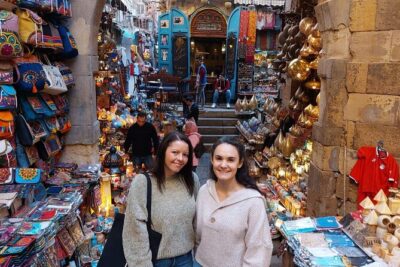
Cairo 8 Hour Private Tour of Pyramids, Egyptian Museum and Bazaar
Read our review →
Private Excursion to Maeklong Railway and Floating Markets
Read our review →
Floating and Railway Market (Optional Waterfall): Private Tour
Read our review →
Shopping in the Souks of Marrakech Private Tour
Read our review →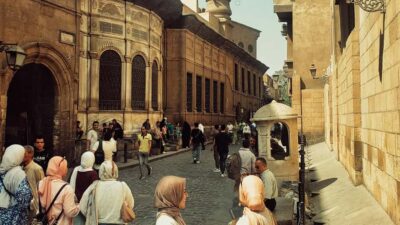
Local Markets & Khan el Khalili Private Shopping Tour
Read our review →
Private Excursion to Floating Market and Ayutthaya World Heritage
Read our review →
Private Heritage Walking Tour in Jaisalmer Fort and Old Bazaar
Read our review →Browse the lists this tour appears in