
Review · MOROCCO
Fes: Attarine Madrasa, Museum, Tannery, Souk and Medina Tour
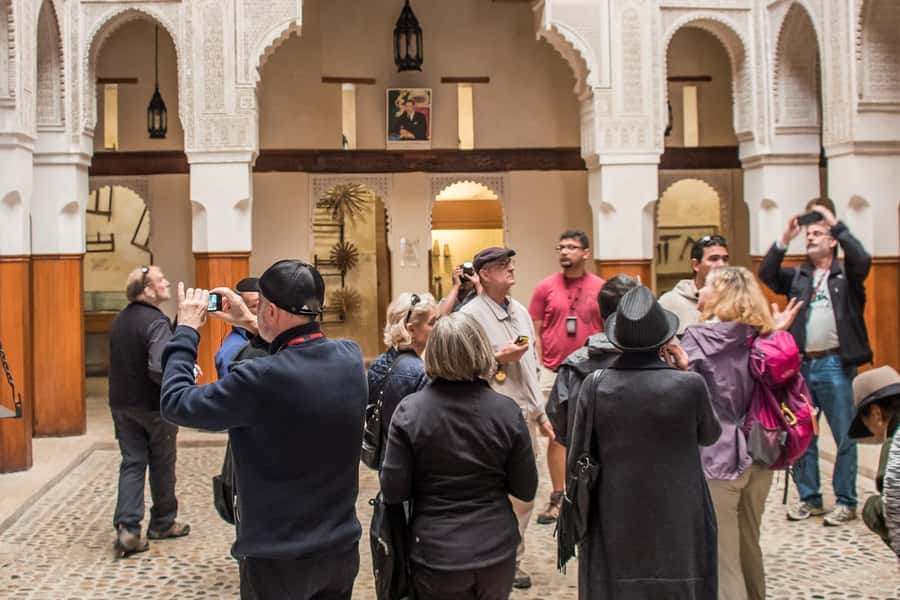
Fes rewards a good guide. This four-hour walk brings together the city’s finest sights, from the 14th-century Attarine Madrasa to the working dye pits at Chouara Tannery. I especially like the small-group format and the way the route mixes grand monuments with working craft shops, souks, copper workshops, and narrow lanes. The main drawback is simple: Fes Medina is physically demanding, and the tour is not suitable for people with mobility impairments.
At $12 per person, this is an unusually low-cost way to get oriented in one of Morocco’s hardest old cities to navigate alone. I also like that you get free time at several stops rather than being marched past everything. Just remember that the two main museum and madrasa admission fees are extra, and the tour may finish at Hotel Batha rather than at your original meeting point.
Key things to know before booking
- The route covers Fes’ essential sights: Bab Bou Jeloud, Attarine Madrasa, Karaouine Mosque, Chouara Tannery, Nejjarine Museum, and the Medina.
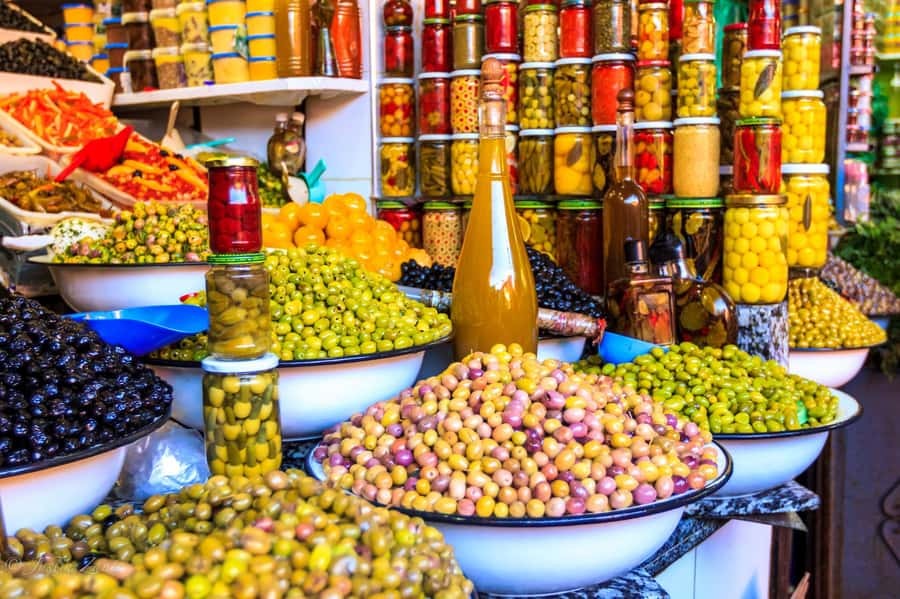
- The Medina is the real star: You walk through souks selling spices, leather, pottery, textiles, perfumes, and zellige tiles.
- The guide matters greatly: Named guides such as Houssine, Mouanis, Youssef Elbargui, Amin, and Jamal have been praised for clear explanations, patience, and easy navigation.
- The price is excellent value: The $12 tour fee does not include 20 MAD entry to Attarine Madrasa or 20 MAD entry to the Nejjarine Museum.
- Expect a serious walking tour: You will use narrow lanes for up to four hours, with limited comfort for anyone who has trouble walking.
- Shopping is part of the route: You will see textile, leather, pottery, argan oil, and craft stops. You are not required to buy anything.
Why a guide helps in Fes Medina
Fes Medina is not a place where a quick map check solves everything. The old city is a maze of narrow lanes, small squares, covered souks, workshops, mosques, fondouks, and dead ends. A guide gives the walk shape and helps you notice what you would otherwise pass without understanding.
This is also a city where the walls tell only part of the story. Your guide can explain how the Medina developed over roughly 1,200 years, how religious schools supported learning, and why craft traditions remain central to daily life. The strongest guide feedback points to clear history, good English, friendly manners, and a knack for answering questions without turning the tour into a lecture.
The named guides vary by booking. Houssine appears repeatedly as a patient and engaging choice, while Mouanis is praised for local shopping advice and a warm manner. Youssef Elbargui, Amin, Jamal, Rachid, and others have also received strong praise for their command of the streets and the city’s past. You should not expect one specific guide unless the provider confirms that in advance, but the guide quality appears to be one of this tour’s main strengths.
More Museum Visits in Morocco:
- Fes: Bou Inania Madrasa, Museum, Tannery, Souk & Medina Tour
★ 4.7 · 74 reviews - Dubai: Old Town, Creek, Museums, Souks, & Street Food Tour
★ 4.8 · 10,816 reviews - Cairo 8 Hour Private Tour of Pyramids, Egyptian Museum and Bazaar
★ 5.0 · 2,931 reviews
Starting at Bab Bou Jeloud, Fes’ Blue Gate
The tour begins at Bab Bou Jeloud, often called the Blue Gate. It is a useful meeting point because it marks the western entrance to the old city and gives you an immediate sense of the contrast ahead: open space outside the gate, then tight lanes and layered activity inside.
The stop itself is brief, about 10 minutes, so think of it as your orientation rather than a full visit. Your guide introduces the route, explains the basic layout, and leads you through the Medina. If you are staying in a riad inside the old city and have booked the private option, pickup from the riad reception may be available.
If your accommodation is outside the Medina, you meet at Hotel Batha on Avenue de La Liberte. Confirm the meeting details by WhatsApp when the provider contacts you one or two days before the walk. That message should include the guide’s name, meeting point, and practical reminders.
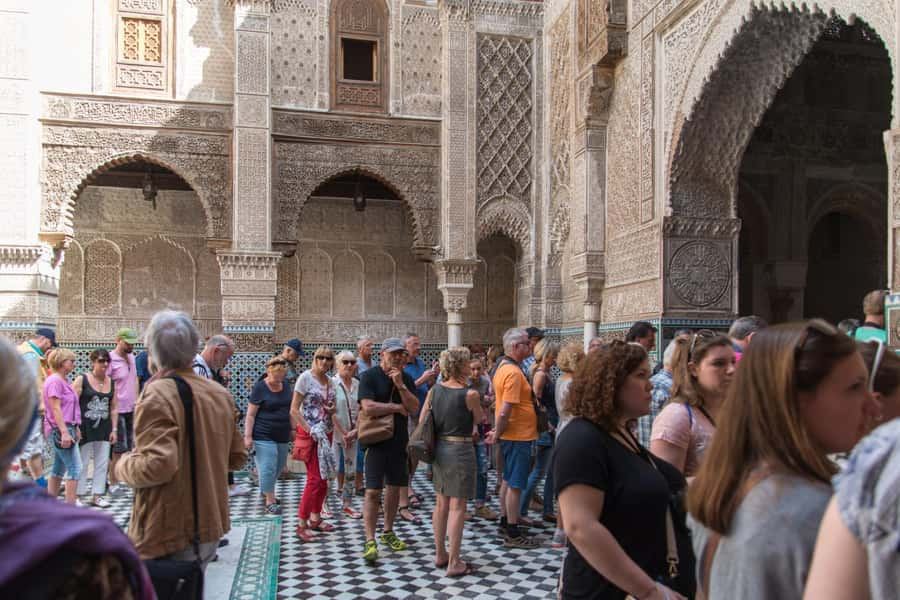
Attarine Madrasa and Marinid design
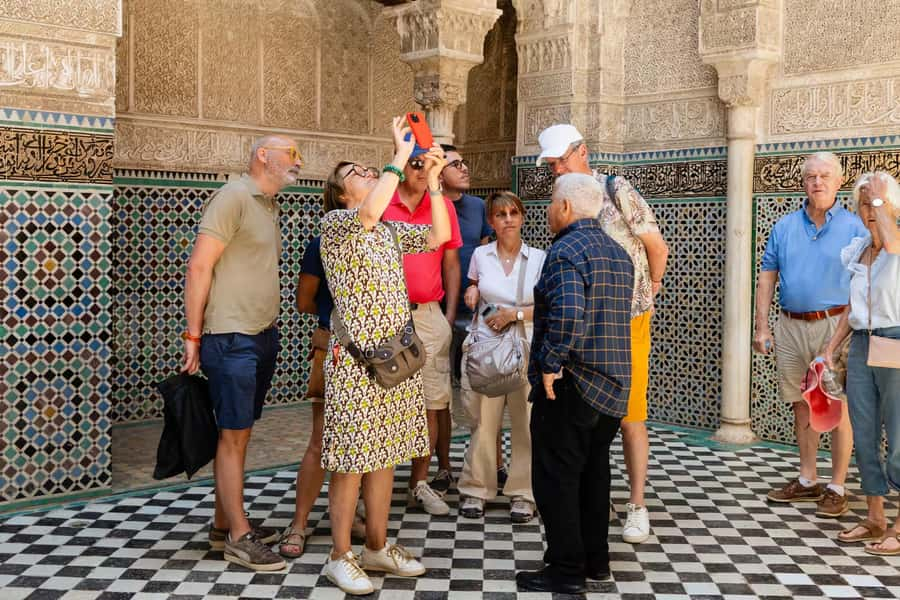
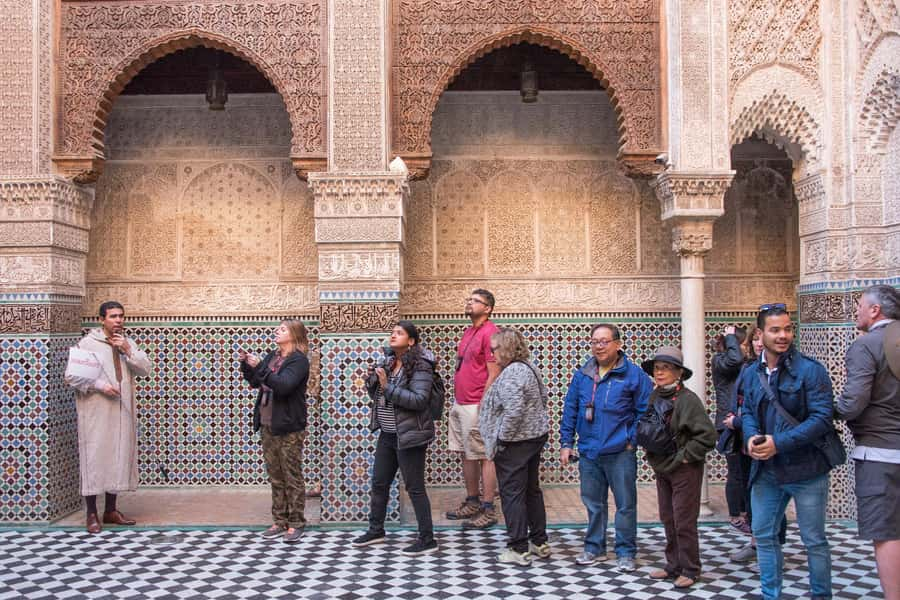
The first major monument is Al Attarine Madrasa, built in the early 14th century under Sultan Abu Sa’id of the Marinid dynasty. It was once a Quranic school, and its courtyard shows why Marinid architecture remains one of Fes’ great pleasures.
Look closely at the details rather than trying to take in the whole building at once. The decoration includes zellige tilework, carved cedar, marble columns, and carefully balanced geometric patterns. The courtyard is compact, which makes the ornament easy to study. Your guide can also explain the madrasa’s role in religious education and the place of learning in Fes life.
The planned stop lasts about 35 minutes, including the guided visit, photographs, and free time. That is enough for a good look, though anyone who loves architecture may wish the schedule allowed longer. Admission costs 20 MAD per adult and is not included in the tour price.
The tour advertises skip-the-line access to selected monuments. That can save time during busy periods, though entry arrangements can vary. Keep some Moroccan dirhams in your pocket rather than assuming every small fee is covered.
Karaouine Mosque and University from the outside
Next comes the exterior of the Al-Karaouine Mosque and University. Fatima al-Fihri founded it in 859, and it became one of the oldest and most important centers of Islamic learning. The building’s green-tiled roofs and large doors give you a strong visual connection to Fes’ religious and academic life.
For most visitors, the key point is that this is an exterior visit. Non-Muslim visitors should not expect a standard interior sightseeing stop. The value comes from seeing the mosque in its Medina setting and hearing how the institution shaped the city’s identity.
The scheduled time is about 30 minutes, enough for photographs and explanation. This is one of the places where a guide adds real value. Without context, you might see a handsome doorway and move on. With context, you begin to understand why Fes grew around institutions of worship, study, trade, and craft.
A few more market tours around Morocco worth a look
- Marrakech: Bahia Palace, Saadian Tombs, Souk and Medina Tour
★ 4.7 · 4,974 reviews - Marrakech: Ben Youssef, Secret Garden, & Souks Walking Tour
★ 4.6 · 2,802 reviews - Marrakech: Colorful Medina Souks Guided Walking Tour
★ 4.7 · 2,470 reviews - Marrakech: Traditional Moroccan Cooking Class & Market Visit
★ 4.8 · 1,861 reviews
Nejjarine Museum and the old fondouk
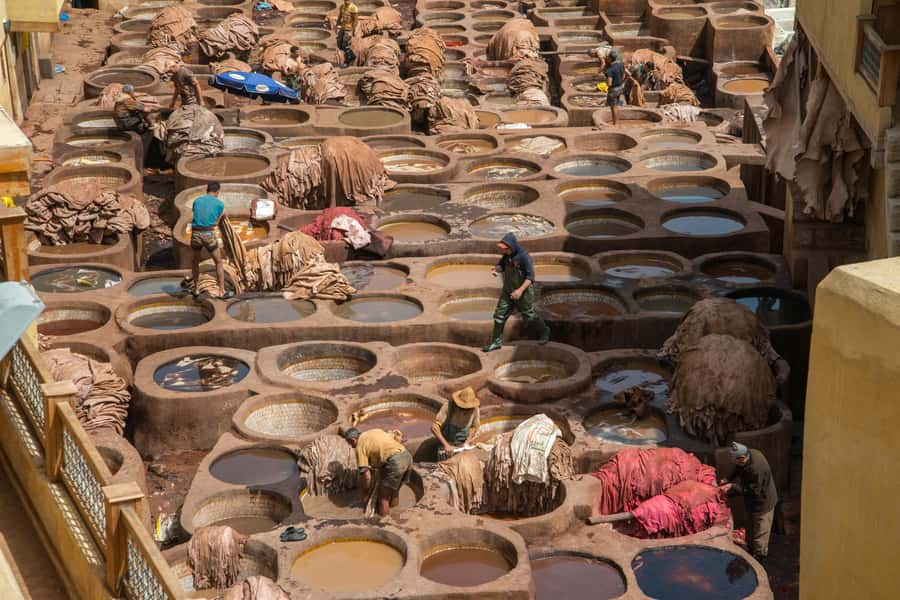
The Museum of Wooden Arts and Crafts occupies a restored fondouk, or caravanserai, known as Nejjarine Fondouk. The building once provided space for merchants and travelers, and its restored structure is part of the attraction.
Inside, the collection focuses on Moroccan woodwork, including carving, marquetry, antique furniture, and traditional objects. This stop gives the tour a quieter rhythm after the Medina streets. You can study the workmanship in a more orderly setting and connect it to the carved cedar seen at Attarine Madrasa.
About 20 minutes are planned here. That is enough for a focused visit, though not a detailed museum tour. Admission is another 20 MAD per adult, paid separately.
The route may also include shopping at this point. That is worth noting if you prefer a purely historical walk. The shopping stops are part of the craft economy, and several people have found the local advice helpful, but you should feel free to look without buying. One useful feature of the guide service is that a polite no is generally respected.
Chouara Tannery and the dyeing pits
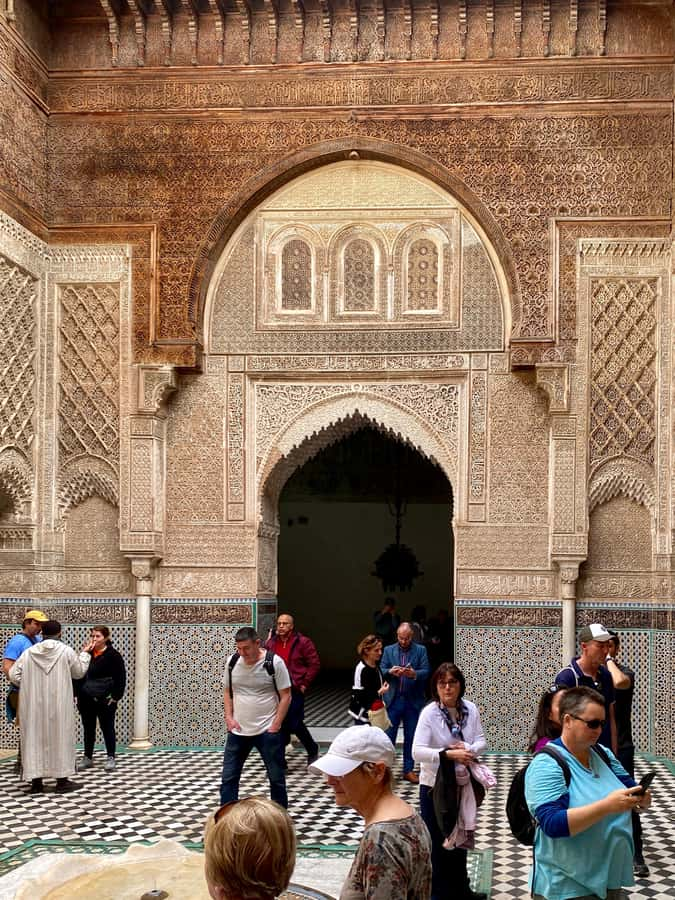
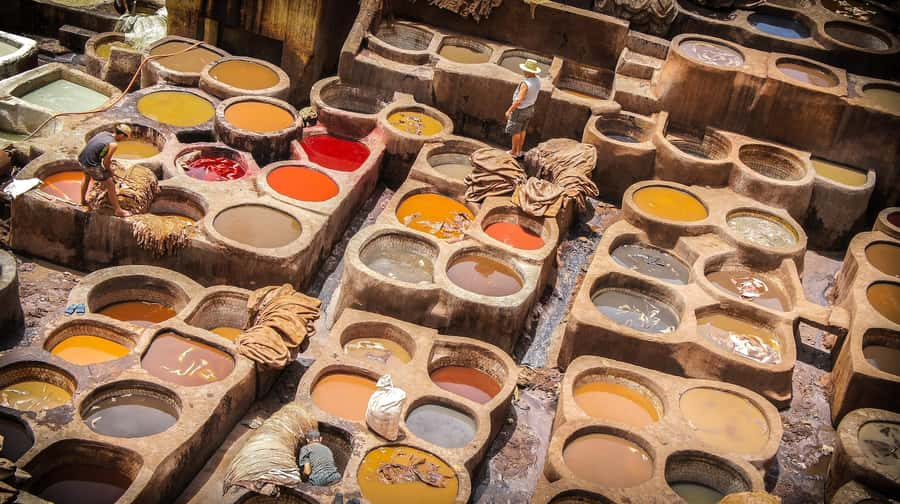
Chouara Tannery is the tour’s most famous working sight. From a terrace, you look down at the round dyeing pits where leather is soaked, treated, and colored by hand. The process uses traditional methods and natural dyes such as saffron and indigo.
The view is memorable because it combines color, labor, and an old trade still operating inside the Medina. You are not simply looking at a display made for tourists. You are seeing a craft process tied to Fes’ long leather tradition.
The stop lasts about 35 minutes, including explanation, photographs, and time to look around. Tannery terraces are often connected to leather shops, so shopping may be offered. You can compare wallets, bags, belts, slippers, and other goods, but do not confuse the viewpoint with a neutral museum. It is also part of a commercial setting.
The smell can be strong. That is not a flaw in the tour, but it is worth preparing for. Bring water, wear shoes that can handle a long walk, and do not plan this as a delicate, polished attraction. It is hands-on, noisy, and very much part of working Fes.
Through the souks of textiles, spices, and copper
The middle and later sections of the walk take you through several distinct souks. Souk Sabaghine is associated with handwoven textiles and traditional fabrics. Souk El Attarine focuses on spices, perfumes, and herbal products.
This is where the tour becomes less about isolated monuments and more about how the Medina functions. You see goods made, sold, carried, and used within the same old city. The sensory side of Fes is strong here: colored fabrics, piles of spices, perfume bottles, leather goods, and the constant movement of people through lanes too narrow for ordinary road traffic.
Near Hammam Seffarine, you can hear coppersmiths working metal. The sound of hammering is a useful reminder that these souks are not only shopping streets. They are workshops and workplaces, with skills passed down across generations.
The route includes around 45 minutes of Medina walking and free time, but the actual pace depends on your group and how often you stop. Small groups have a clear advantage. They can fit through tight lanes more easily, and the guide can respond to questions without losing half the group at a turn.
Pottery and zellige craft in practical detail
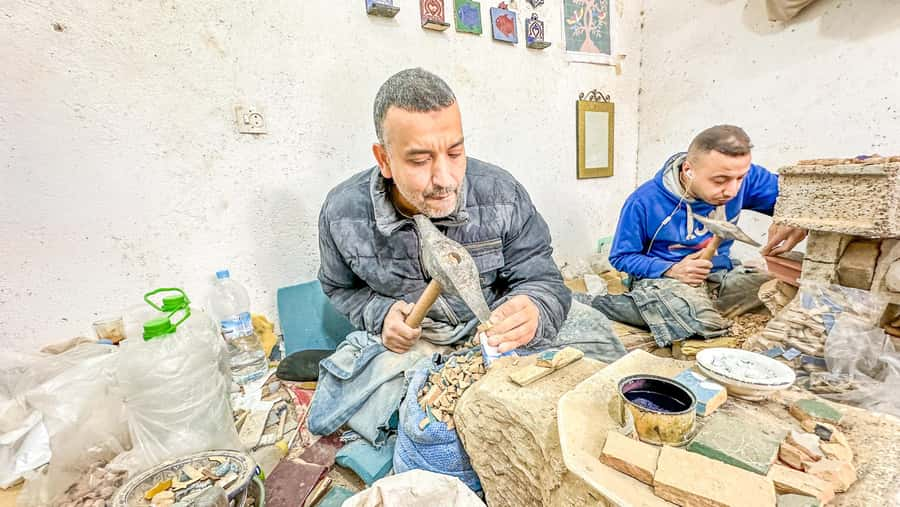
The pottery and zellige workshop adds another layer to Fes’ craft story. You may see artisans shape clay, paint ceramics by hand, and cut small tiles for mosaic designs.
Zellige is not simply a colorful surface. The tiles are cut into precise shapes and arranged into geometric patterns used on fountains, palaces, mosques, and homes. Seeing the work at close range helps explain why Moroccan tilework takes so much time and why small imperfections can be part of handmade production.
As with the leather and textile stops, this may lead into a shop. The benefit is that you can see the connection between production and sale. The downside is that the stop may feel commercial if you hoped for a strictly sightseeing-focused route.
I would treat these visits as optional buying opportunities, not obligations. If you want advice on quality or fair prices, ask your guide directly. Several named guides have been praised for helping with local shopping while allowing people to browse at their own pace.
Timing, walking, and what to carry
The tour is listed as 210 minutes to four hours. That range matters. A shorter version may move briskly through the route, while a longer one gives you more time for questions, photographs, and shopping.
Wear comfortable shoes. The Medina route involves extended walking through narrow streets, and the tour is specifically not suitable for people with mobility impairments. The activity is also described as wheelchair accessible, but those two points do not fit neatly together. If you use a wheelchair or have difficulty walking, contact the provider before booking and ask what route and access arrangements apply to your date.
Bring sunglasses, a sun hat, water, and cash. Cash covers the 20 MAD Attarine ticket, the 20 MAD Nejjarine Museum ticket, and any small purchases. Food and drinks are not included, so eat beforehand or plan your own refreshment stop.
The tour is offered in English and French. Private groups are available, and the private option may include pickup from a riad inside the Medina. Transportation is not included, so accommodation outside the old city requires your own way to Hotel Batha.
Is the $12 price good value?
Yes, provided you understand what the fee covers. For $12 per person, you receive a licensed local guide, a planned route through major sights, help navigating the Medina, free time at selected monuments, and a private or small-group format depending on the option you select.
The two listed admission fees add 40 MAD per adult if you visit both Attarine Madrasa and the Nejjarine Museum. Transportation, meals, and drinks are extra. Even with those costs, the tour remains good value because the largest benefit is not admission. It is the guide’s ability to connect the places and keep you from wasting time in the maze.
The price is especially appealing for a first day in Fes. You get a working map of the old city in your head, learn which areas interest you, and can return later to shop or explore independently. If you already know the Medina well and prefer wandering alone, the tour will feel less essential.
Who should book this Fes walk?
I would recommend it most strongly to first-time visitors, solo travelers, couples, and families who want cultural context without paying for a full-day private tour. It also suits anyone nervous about getting lost in the Medina.
Families should consider the walking time. One guide, Joanne, was praised for adjusting the pace for an elderly parent, and other feedback points to patient guides who stop for photos and questions. Still, the narrow streets and four-hour schedule can wear down young children or older adults.
It is also a good fit for independent shoppers who want a local introduction before returning on their own. The guide can explain the craft districts and point out useful areas, while you decide what, if anything, to purchase.
I would be more cautious if you want a museum-heavy experience, dislike commercial stops, or have significant mobility limits. This is a street-level tour, not a relaxed coach excursion.
Should you book it?
Book this tour if you want a low-cost, well-rounded first look at Fes, especially if you are staying inside or near the Medina. The strongest reasons are the guide support, the practical route through the souks, and the mix of major monuments with living crafts.
Before paying, confirm three details: your meeting point, whether you have selected a private or small-group option, and where the tour will finish. The stated ending is Hotel Batha, and one booking ended away from the starting point, requiring the group to find its own way back.
For most visitors, the small extra effort is worth it. Fes is easier to appreciate once someone helps you read its doors, workshops, schools, and street plan. At this price, the tour gives you that first layer of understanding without taking over your whole day.
FAQ
How long does the Fes Medina tour last?
The tour lasts between 210 minutes and four hours, depending on the selected option and schedule.
Where does the tour meet?
The standard meeting point is in front of Hotel Batha on Avenue de La Liberte in Fes. If you stay inside the Medina and choose the private option, pickup from your riad reception may be available.
Which languages are offered?
The live guide service is offered in English and French.
Are entrance tickets included?
No. Entry to Attarine Madrasa costs 20 MAD per adult, and entry to the Nejjarine Museum of Wooden Arts and Crafts costs 20 MAD per adult.
Is transportation included?
No. Transportation is not included. Guests staying outside the Medina can travel to the Hotel Batha meeting point independently.
Is the tour suitable for wheelchair users or people with mobility problems?
The activity information describes it as wheelchair accessible but also says it is not suitable for people with mobility impairments. Contact the provider before booking to confirm the route and access arrangements for your needs.
Can I cancel or pay later?
You can cancel up to 24 hours before the tour for a full refund. The reserve-now, pay-later option lets you book without paying immediately.
Just added around Morocco
- Moroccan Cooking Class with a Local Family & Market Visit★ 5.0 · 16 reviews
- Market Tour & Moroccan Cooking Class in Casablanca with Transfers★ 5.0 · 18 reviews
- Private Market Tour & Cooking Class in Casablanca with Transfers★ 5.0 · 20 reviews
- 5 am in Casablanca: Mosque, Medina, Beach , Souks , Coffee and more★ 5.0 · 11 reviews
- Casablanca Market and Street Food Walking Tour★ 5.0 · 3 reviews
- Half day tour : Agadir Goats in argan trees & Souk El Had Market★ 3.5 · 6 reviews
- Agadir city Tour with big Souk Elhad★ 5.0 · 5 reviews
- Paradise Valley & Gorge Adventure with Souk & Transfer★ 4.0 · 5 reviews
Museums, compared.
Old Town, Creek, Museums, Souks, & Street Food Tour
Read our review →
Cairo 8 Hour Private Tour of Pyramids, Egyptian Museum and Bazaar
Read our review →
Female-Guided Pyramids, Sphinx & Museum City Tour
Read our review →
Frida Kahlo VIP [Museum Tickets Included] Bike, Markets & Churros
Read our review →
Frida Kahlo VIP [Museum Tickets Included] Walk, Markets & Churros
Read our review →
Day Tour to Giza Pyramids Complex, Egyptian Museum & Bazaar
Read our review →
The Egyptian Museum, the Citadel, Khan Khalil Bazaar & Old Cairo
Read our review →
Browse the lists this tour appears in