
Review · BRISTOL COUNTY, UNITED KINGDOM
Bristol: Air Raid Shelter & St. Nicholas Market Walking Tour
Bristol has secrets below street level. This tour links the city’s old trading quarter with its only public subterranean tour, taking you from the Corn Exchange through wartime streets and into a preserved World War II air raid shelter. I especially like the mix of street history and underground access, plus the chance to finish at St. Nicholas Market for food and souvenirs. The main drawback is that the shelter remains a developing attraction, not a finished museum, and the confined spaces will not suit everyone.
The guides are another strong point. Owen, Duncan, and Theresa have each been praised for clear storytelling, humor, and real commitment to Bristol’s past. I also like that the tour works for locals as well as first-time visitors. You may know Bristol well and still learn something new. Just allow for uneven surfaces, limited mobility, and a few tight areas below the Corn Exchange.
Key points to know before booking
- The shelter is the star: You enter Bristol’s largest public air raid shelter, a preserved space beneath the Corn Exchange.
- The walk begins above ground: Expect old streets, Blitz damage, historic buildings, and stories about Bristol’s trading past before you go below the city.
- The Corn Exchange has extra layers: The tour includes access to areas linked with 1960s music, including rooms associated with the Rolling Stones.
- St. Nicholas Market gives the tour a tasty finish: Food and drinks are not included, but you can buy sweet and savory treats afterward.
- The guides make the difference: Owen, Duncan, and Theresa are praised for clear delivery, humor, costume, and strong personal interest in the subject.
- Plan for a practical visit: Wear comfortable shoes, and avoid booking if you have serious mobility limits, claustrophobia, or a body weight above 300 pounds, or if you are over 95.
Starting at the Corn Exchange
Meet at the main entrance of the Corn Exchange. This is a useful starting point because the building links several parts of the experience: Bristol’s commercial past, its wartime shelter, and its later music history.
The guide begins by setting the scene in the old city. You are not simply led from one landmark to another. Instead, the streets become part of the story, showing how Bristol grew as a trading center and how war changed the city around them.
The tour is conducted in English. Some guides wear World War II costume, which adds a little theater without turning the subject into a staged show. Owen and Duncan have been especially praised for making the information easy to follow, while Theresa has been noted for bringing wartime stories to life.
That personal delivery matters here. The shelter itself is important, but empty rooms do not explain themselves. A good guide helps you picture what the space meant to Bristol residents during air raids, and the strongest part of this experience is the way the guides connect physical remains with human stories.
More Market Walking Tours in the UK
- Air Raid Shelter + St. Nicholas Market Walking Tour
★ 5.0 · 1,950 reviews - London Food Walking Tour: Taste Your Way Through Soho & Chinatown
★ 5.0 · 187 reviews - Food & drink walking tour in South East London. Bermondsey – Borough Market.
★ 5.0 · 79 reviews
Walking through Bristol’s Old City
Before heading underground, you walk through the old city for roughly 85 minutes, though the full experience can vary between about 75 minutes and two hours. The route covers ancient streets, striking architecture, and areas affected by the Blitz.
The focus is not only World War II. You also hear about around 1,000 years of Bristol’s trading past, giving the wartime section a wider setting. That is useful because Bristol’s air raids did not happen in isolation. They affected a working city shaped by commerce, markets, streets, and public buildings.
One particularly important area is the Temple Church and the streets around Wine Street and Corn Street. The guide points out Blitz damage and explains how the bombing affected Bristol. These details make the later visit to the shelter more meaningful. You first see the city above ground, then learn what people needed below it.
I like this part of the tour because it keeps the experience from becoming a single-topic attraction. If you are mainly interested in military history, the air raid shelter will be your main reason to book. If you want a broader introduction to Bristol, the old-city walk gives you more value for the same ticket.
The pace also seems well judged for most people. One participant described the tour as lasting about an hour and 15 minutes, while others found it closer to two hours. You should not treat the advertised duration as exact. The guide may spend more time on questions, stories, or objects depending on the group.
Entering Bristol’s World War II air raid shelter
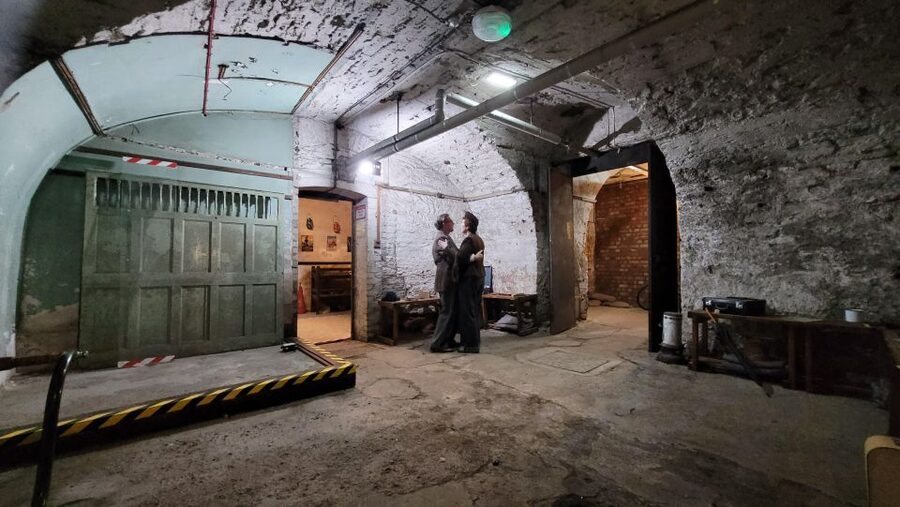
The major moment comes when you go beneath the streets into Bristol’s biggest public air raid shelter. This is the part that makes the tour different from a standard old-town walk.
The shelter remains largely untouched, and that lack of polish is part of its appeal. You are not entering a glossy modern exhibition with every surface rebuilt. Instead, you see a place that feels like a surviving slice of wartime Bristol. The atmosphere comes from the rooms themselves, the underground setting, and the guide’s explanation of how people used them.
Owen has been praised for helping people imagine what it must have been like inside the shelter. Duncan’s passion has also been singled out, particularly in connection with the effort to preserve and develop the site. These are not minor details. In a space with limited museum displays, the guide carries much of the interpretation.
You may also hear about Margaret, the friendly ghost associated with the shelter. This gives the visit a lighter, slightly spooky touch. It is best treated as local tour lore rather than the central point of the experience. The shelter’s real interest is its wartime function and physical survival.
The underground section may include World War II objects and early museum displays. Several people wanted more time to study the artifacts and written material, which tells you something useful: there is enough to look at, but the current presentation is still growing. If you enjoy small museums and would rather read every label slowly, you may find the pace a little quick.
That is also the main limitation. The attraction is still developing, and some of the shelter needs more renovation and support. You should book it for access, atmosphere, and storytelling, not for a finished national museum. The rough edges are honest, but they may disappoint anyone expecting polished displays.
The Corn Exchange’s unexpected music connection
The tour also includes exclusive areas of the Corn Exchange. These rooms have a later story, linked with the best-known bands of the 1960s, including the Rolling Stones.
This gives the experience a welcome change of tone. You begin with Bristol’s medieval and trading past, move into the destruction of the Blitz, then discover that the same building later had a connection with live music. It is a reminder that historic buildings do not belong to only one period.
The music section is not presented as a separate concert-history tour, so you should not expect a long examination of 1960s popular culture. Its value is in the surprise and contrast. The Corn Exchange becomes more than a meeting point. It is part of the city’s commercial, wartime, and entertainment story.
Same place, a different set of stalls:
- London Bridge & Borough Market Food Tour with 7 Authentic Dishes
★ 5.0 · 1,972 reviews - London: Borough Market Food Tour with 6+ Authentic Tastings
★ 4.8 · 533 reviews - London Borough Market & London Bridge Food Tour
★ 5.0 · 519 reviews - London E-Bike tour & Borough market
★ 4.5 · 316 reviews
Finishing at St. Nicholas Market
The tour ends at St. Nicholas Market, or at the Corn Exchange depending on the arrangement. St. Nicholas Market is the better finish if you want to continue exploring, since you can buy food and browse souvenirs immediately afterward.
Food is not included in the $16 ticket, but that is reasonable here. You can choose what suits you rather than being tied to a set meal. Pick up something sweet, choose a savory snack, or simply walk through the market stalls before making another plan.
The market also helps turn the tour into a morning or lunchtime activity. You get Bristol’s old streets, the underground shelter, and then a chance to experience one of the city’s established market spaces. If you have limited time in Bristol, this combination is efficient.
Do not expect the market portion to be a long food tasting session. The tour gives you an introduction and leaves the buying to you. That keeps the ticket price down, but you should bring extra money if you want lunch or a treat.
How much value do you get for $16?
At $16 per person, this is good value if you care about local history and unusual access. The price covers the guide, entry to the World War II shelter, and access to areas of the Corn Exchange that are not usually open to the public.
You are paying for more than a walking tour. A normal old-city walk may explain Bristol’s buildings and trading past, but it is unlikely to take you under the Corn Exchange into a preserved air raid shelter. A museum visit may offer more display space, but it will not give you the same guided route through the streets connected to the story.
The value depends on your expectations. If you want a large collection of artifacts, spacious galleries, and long independent viewing time, this may feel limited. If you want an unusual place, a strong guide, and a compact way to understand wartime Bristol, the price is easy to justify.
The ticket also includes free cancellation up to 24 hours before the start time and a reserve-now, pay-later option. Those terms are useful if your Bristol schedule is still changing, but the main buying decision is simpler: pay a modest amount for access to a place you normally cannot visit alone.
What the guides do best
The strongest praise is directed at the guides. Owen is often described as enthusiastic, clear, and well prepared. Duncan is praised for creating the project and for bringing strong personal energy to the subject. Theresa is also noted for making the stories lively.
You will hear a mixture of facts, local stories, wartime explanation, and humor. That balance helps the tour work for different ages. It is informative without feeling like a lecture, and theatrical without becoming a costume performance.
The guides also make the tour accessible in an important sense: they explain what you are seeing as you go. This matters in the shelter, where the rooms may not have extensive signs or finished displays. You are not left to guess why a particular space matters.
One useful practical point is that the guide’s voice and delivery have been praised. Still, outdoor streets and underground rooms can create sound challenges, so staying near the guide is sensible. If you have hearing difficulties, ask the guide to speak up or repeat information when needed.
Who should book this Bristol tour?
I would recommend it to people who enjoy local stories, wartime history, old buildings, and places that are not part of the standard sightseeing circuit. It is also a good choice for Bristol residents. Several local participants learned new details about their own city, especially about the bombing raids and shelters.
Families with older children may enjoy it because the route changes setting several times. You walk through the city, enter the shelter, hear about music history, and finish near food stalls. The ghost story adds a small spooky note without changing the historical focus.
The tour suits solo visitors and couples too, especially if you want a compact introduction to Bristol before exploring on your own. It is less suitable for anyone who needs step-free access, struggles with confined spaces, or cannot manage comfortable walking shoes.
The stated restrictions are specific: it is not suitable for people with mobility impairments, claustrophobia, a body weight over 300 pounds or 136 kilograms, or people over 95 years old. These rules are connected to the underground setting and physical conditions, so take them seriously before booking.
Practical tips for a smoother visit
Wear comfortable shoes. That is the one item specifically recommended, and it makes sense because the experience combines an outdoor walking route with underground rooms.
Allow extra time after the tour if you want to eat at St. Nicholas Market. Food and drinks are available to buy, but they are not part of the ticket.
If you enjoy museum displays, try to listen carefully during the shelter visit and ask questions when there is a chance. Some people wanted longer to examine the artifacts and articles, so you may need to choose between reading everything and keeping up with the group.
Finally, remember that this is a developing historical attraction. The shelter may receive more support and additional museum space in the future, but its current unfinished quality is part of what you see now. You are visiting a preserved place that is still being interpreted, not a fully polished exhibition.
Should you book the Air Raid Shelter and Market Tour?
Yes, if you want an unusual and well-priced look at Bristol. The shelter access is the main reason to go, and the old-city walk gives it useful context. Add the Corn Exchange’s music connections and a finish at St. Nicholas Market, and you get a lot from a short tour.
Book it especially if you like history told through places rather than only through display cases. Owen, Duncan, and Theresa bring energy to a site that has limited museum infrastructure, and that human storytelling is central to the experience.
Skip it if you need step-free access, dislike enclosed spaces, or expect a large, polished museum. For everyone else, this is a smart way to see a lesser-known side of Bristol for $16, with enough time left afterward for lunch and further exploring.
FAQ
Where does the tour begin?
Meet at the main entrance of the Corn Exchange in Bristol.
Where does the tour finish?
The tour may finish at St. Nicholas Market or return to the Corn Exchange.
How long does the tour last?
The stated duration is about 75 minutes to two hours. The exact length can vary depending on the group and the guide.
What language is the tour in?
The live guided tour is conducted in English.
Is entry to the air raid shelter included?
Yes. Entry to the World War II air raid shelter is included in the tour price.
Is food included?
No. Food and drinks are available to buy at St. Nicholas Market after or during the market portion of the experience.
What should I bring?
Wear comfortable shoes for the walking route and underground visit.
Who should not book this tour?
The experience is not suitable for people with mobility impairments, claustrophobia, a body weight over 300 pounds or 136 kilograms, or people over 95 years old.
Just added around the UK
- Self-Guided Craft Beer Tour (Explore Old Market)★ 4.5 · 19 reviews
- Discover Belfast with St. George’s Market Minivan Tour★ 5.0 · 4 reviews
- Secrets of London Bike Tour: Thames, Tower Bridge & Market★ 4.8 · 42 reviews
- London: Markets, Street Art, and Camden Town Walking Tour★ 5.0 · 5 reviews
- London: Camden Market Food Tour with 7 Street Food Tastings★ 4.8 · 29 reviews
- London: Indian Cooking Masterclass with Market Tour★ 5.0 · 3 reviews
- London Ultimate East End Food & Market Tour with a Local★ 5.0 · 3 reviews
- London: Borough Market Delicious Doughnut & Tea Experience★ 4.7 · 14 reviews
Walking Tours, compared.

City Highlights Temple and Market Walking Tour
Read our review →
Tokyo Tsukiji Fish Market Food and Culture Walking Tour
Read our review →
Ben Youssef, Secret Garden, & Souks Walking Tour
Read our review →
Air Raid Shelter + St. Nicholas Market Walking Tour
Read our review →
Nishiki Market Brunch Walking Tour (7 Tastings + Brunch)
Read our review →Tsukiji Fish Market Food and Culture Walking Tour
Read our review →Browse the lists this tour appears in