
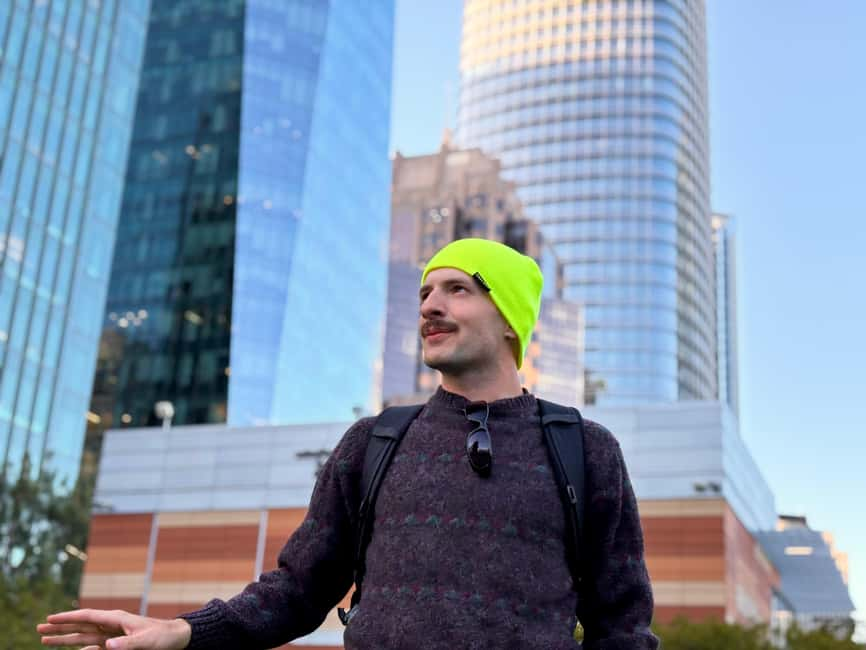
Review · CALIFORNIA, UNITED STATES
San Francisco Technology and History Tour: South of Market
Tech history hides in plain sight. This 70-minute South of Market walking tour connects venture capital, shipping, urban renewal, and today’s technology companies in a compact route. I like the sharp contrast between old San Francisco and the new one, and I like that guide Wes brings both historical research and firsthand startup experience. The main consideration is pace: you cover several major subjects in a little over an hour, so this is an introduction rather than a full study of SoMa.
I also appreciate the mostly flat route, a real advantage in a city famous for steep streets. The tour is wheelchair-accessible, and the stops at South Park, Yerba Buena Gardens, and Salesforce Park provide welcome places to pause. If you want a tour built around classic cable cars, Victorian houses, or food, this is not it. It is best for curious people who want to understand how San Francisco changed, and why the technology economy took root here.
Key points about the South of Market tour
- South Park connects five different eras: gold rush camps, elite development, earthquake refugees, Japanese community life, industry, and modern technology offices.
- Wes combines local work experience with urban history, giving the tech story more substance than a simple list of company names.
- The route follows important transport and development corridors, including 2nd Street and the former path toward Pacific Mail Steamship Company docks.
- Yerba Buena Gardens raises difficult questions about urban renewal, displacement, and the people removed to make way for a new downtown district.
- Salesforce Park offers a rooftop ending, with views toward the San Francisco skyline and the Bay.
- The $30 price is reasonable if you value interpretation and context, though the short duration means the tour moves quickly.
Why this SoMa walk tells San Francisco’s larger story
South of Market is one of the best places to see San Francisco change block by block. The area has been a port district, an industrial quarter, a low-income neighborhood, a center of LGBTQ history, and a home for technology companies. You do not simply look at old buildings here. You compare what stood in their place before.
The tour’s central idea is that San Francisco’s technology success did not appear out of nowhere. It grew beside older systems of shipping, rail, finance, land reclamation, and commercial development. That makes the experience useful even if you are not interested in startups.
Wes is especially well suited to this subject. He works in the neighborhood and has experience with startups, so he can explain the technology world from inside it while still asking hard questions about development. The strongest praise for the experience centers on his energy, personal connection to the area, and ability to link urban planning with everyday city life.
You should expect an English-language walking tour for a private group or a scheduled group, depending on the option you choose. At $30 per person, the price is fair for a live guide who adds interpretation rather than simply pointing out buildings. You are paying for the story, not admission to a major attraction.
More History Tours in the USA:
- 2 Hour Historic Market Food Tour and Hands-On Biscuit Class
★ 5.0 · 251 reviews - 2-Hour Food, History and Street Art Tour of Ponce City Market
★ 5.0 · 159 reviews - Philadelphia Historic Centre Food Tour with 5 Authentic Tastings
★ 5.0 · 117 reviews
South Park and the roots of venture capital
The tour begins in South Park, at or near 162 South Park Street, though your exact meeting point can vary with the booking option. Plan to arrive ready to walk, since the group spends about 10 to 15 minutes here before heading north.
South Park is one of San Francisco’s oldest neighborhoods. Its design was modeled after a British garden square in the 1850s, giving it a different feel from the city’s tightly packed streets. Seating and shade make this a useful place to settle in and get your bearings.
What makes South Park special is its long list of former identities. It began as a gold rush encampment, later became a luxury development during the Gilded Age, and served as a refugee camp after the 1906 earthquake. It also hosted San Francisco’s Japanese community and an industrial population before becoming a major technology and finance center.
In the 2010s, the first offices of Instagram and Twitter were located here. Today, the park sits at the center of San Francisco’s venture capital world. That shift gives Wes a natural way to explain why the city became associated with startups, investment, and fast-moving technology firms.
I like this opening because it avoids the usual San Francisco story. You do not begin with the Gold Gate Bridge or Alcatraz. You begin with a small square that shows how land uses and communities can change over time.
The limitation is that South Park is not a large attraction by itself. If you expect a long stop packed with monuments, you may find it modest. Its value comes from the explanation, old photographs, and comparisons between the park you see and the very different place that once occupied it.
2nd Street and the making of a commercial city
From South Park, you walk north along 2nd Street. The route is mostly flat, which matters in San Francisco, and South of Market is generally the city’s easiest major neighborhood for a level walk.
2nd Street has an important connection to the Pacific Mail Steamship Company’s docks. It linked the growing downtown area with the waterfront and helped move people and goods through the city. This was not just another street grid. It was part of the machinery that made San Francisco a commercial center.
The street also marks one of the city’s first major land reclamation projects. One of San Francisco’s large hills was flattened to make space for the thoroughfare. That detail helps you read the current street differently. The flat blocks are not simply natural terrain. They are the result of major engineering and a city willing to reshape its ground for business.
Today, 2nd Street is also associated with companies such as LinkedIn, DoorDash, and Anthropic. That creates one of the tour’s clearest contrasts: the same corridor that once connected downtown with shipping docks now connects offices, investors, and technology firms.
This portion is mostly a walking discussion rather than a series of formal attractions. You will be looking at streets, office buildings, and the way the neighborhood fits together. That is a strength if you want to understand how a city functions, but it may feel less exciting if you prefer interior visits or famous landmarks.
Comfortable shoes and comfortable clothes are the right choice. The walk is short, but the tour keeps moving between stops, and you will get more from it if you are not distracted by sore feet.
Folsom Street and the human side of development
The route also includes Folsom Street, a place associated with San Francisco’s LGBTQ history. The supplied details do not promise a separate long stop here, so think of it as part of the broader street-level story rather than a dedicated museum visit.
Its inclusion matters because SoMa’s past is not only about factories, docks, and technology offices. The area has been shaped by communities with different needs and identities. Looking at those layers gives you a better sense of what can be lost when a district is treated only as development space.
This is one reason the tour works well for locals as well as first-time visitors. You might know the names of modern companies or have walked through the district before, yet still miss the political and social forces that changed it.
The tour does not present development as an automatic success. Instead, it asks you to look at what was built, who benefited, and who was pushed aside. That balanced approach is more useful than a simple celebration of San Francisco’s technology economy.
A few more market tours around the USA worth a look
- Chef Guided Food Tour of Pike Place Market
★ 5.0 · 3,733 reviews - Pike Place Market Tasting Tour
★ 5.0 · 1,696 reviews - Early-Bird Tasting Tour of Pike Place Market
★ 5.0 · 1,154 reviews - Center City Philadelphia Food Tour with Reading Market
★ 5.0 · 861 reviews
Yerba Buena Gardens and the cost of urban renewal
Yerba Buena Gardens is the tour’s most important stop for understanding urban renewal. You receive a guided explanation of the large redevelopment project that created this downtown public space, along with the people who lived in the area before it changed.
The gardens are pleasant and central, but the story behind them is complicated. Creating the new district required evictions, and those removals affected San Francisco’s political climate. The tour gives you a chance to consider the difference between a successful public project and a fair public process. Those are not always the same thing.
I find this part especially valuable because it moves beyond architecture. You are not only admiring a park. You are asking how a city decides which neighborhoods deserve investment, whose homes are considered expendable, and how displaced residents respond.
The stop is also well placed in the route. After hearing about early shipping and industrial growth, you see a later attempt to remake the same part of town for offices, culture, and public space. Yerba Buena Gardens becomes a visible example of how urban renewal can improve a district while causing real harm to people who already live there.
You should not expect a long independent visit to the gardens. The tour allocates about 15 minutes here, so Wes has to keep the discussion focused. If this subject interests you, make a note of the places you want to investigate later rather than expecting every issue to be settled during the walk.
Salesforce Park and the rooftop view
The final stop is Salesforce Park, the rooftop garden connected with the Salesforce Transit Center, near Salesforce Tower. This is the tour’s most visual ending. From above the downtown streets, you can look toward the skyline and the Bay while discussing the city’s newest major development.
The park is more than a photo stop. It represents the visible arrival of the modern technology economy in central San Francisco. The Salesforce project is described as the largest development in the city’s recent history, making it a fitting place to end a tour about investment, infrastructure, and changing land values.
The site also has an older and less polished past. It was built over a former beachfront natural gas refinery and was once part of Tar Flat, identified here as the city’s poorest neighborhood. That contrast is striking: a rooftop public garden now sits above ground once associated with heavy industry and poverty.
You will also have the chance to see Klockar’s blacksmith. Its presence recalls the district’s early role as a center for metalworking. It is a small but useful reminder that SoMa’s working past has not vanished completely from the modern city.
The rooftop setting makes this a satisfying finish, though the experience depends on access and timing at the site. The tour promises the opportunity to see the garden, skyline, and Bay, but it is not presented as a long free period for exploring every part of the transit center.
How much can 70 minutes really cover?
The tour divides its time into short sections: roughly 15 minutes at the opening, a 15-minute walk, about 15 minutes at Yerba Buena Gardens, another 15-minute walk, and about 15 minutes at Salesforce Park. That structure keeps the route moving and makes the experience easy to fit into a busy San Francisco day.
The tradeoff is depth. South Park alone could support a much longer history lesson, and urban renewal, LGBTQ history, shipping, and technology could each fill an afternoon. In 70 minutes, you get a well-connected framework rather than an exhaustive account.
That is not a flaw if you use the tour as an orientation. I would schedule it early in a San Francisco visit if you plan to spend more time in SoMa, Yerba Buena Gardens, or downtown. You will understand the streets better afterward, and you can return to the subjects that catch your interest.
If you are already an urban history enthusiast, the short format may leave you wanting more. The good news is that the tour gives you several clear leads: South Park’s changing communities, 2nd Street’s altered terrain, the politics of Yerba Buena Gardens, and the transformation from Tar Flat to Salesforce Park.
Price, access, and practical planning
At $30, this is a good-value tour for someone who wants a live guide and a focused explanation of SoMa. The cost is modest compared with many guided city experiences, especially because the route includes several distinct parts of San Francisco rather than concentrating on one building.
The tour is wheelchair-accessible, and the mostly flat neighborhood makes it one of the more manageable walking options in the city. You should still wear comfortable shoes and clothes, since accessibility does not remove the need to move between stops.
The meeting point may vary by booking option, so check your confirmation carefully. The stated starting location is 162 South Park Street, but do not rely on the address alone if your selected option gives different instructions.
The ending is convenient for onward travel. From Salesforce Tower and the transit center area, you have access to BART and MUNI rail lines. Powell Street cable car is about a 15-minute walk away, giving you an easy way to continue toward other central San Francisco sights.
Free cancellation is available up to 24 hours before the tour for a full refund, and you can reserve now and pay later. Those terms are useful if your San Francisco schedule is still shifting.
Who should book this SoMa experience?
I would choose this tour if you want to understand San Francisco beyond its postcard attractions. It suits people interested in technology, city planning, local politics, shipping, architecture, social change, and the way old neighborhoods are remade.
It is also a strong choice for locals. Wes’s direct connection to startups gives the technology discussion more credibility, while his interest in urban history keeps the tour from becoming a company-name parade. The high ratings come mainly from his enthusiasm, personality, personal knowledge of the neighborhood, and skill at comparing historical photographs with the streets in front of you.
Families with older children may enjoy it if they can handle a walking discussion without constant entertainment. It is less suited to very young children, though no age restriction is provided. Visitors looking for food tastings, museum admission, or a long list of famous landmarks should choose a different experience.
Private groups can be arranged, which may be useful if you want to ask more questions or shape the discussion around development and technology. The tour is offered in English.
Should you book the South of Market tour?
Book it if you want a smart, compact explanation of why San Francisco became a technology center and what that success changed. The strongest parts are South Park’s many past lives, 2nd Street’s link to shipping and land reclamation, Yerba Buena Gardens’ difficult urban renewal story, and the rooftop view from Salesforce Park.
Skip it if you want a traditional sightseeing route or a slow, detailed historical walk. For $30, the experience offers strong value, but you must accept a brisk pace and a broad range of topics.
For most curious visitors, I would book it near the start of a San Francisco stay. It gives you useful context for the streets, companies, parks, and transit projects you will see afterward, and it ends in a convenient part of downtown.
FAQ
How long is the South of Market tour?
The walking tour lasts 70 minutes.
What is the price?
The price is $30 per person.
Where does the tour begin?
The listed starting location is 162 South Park Street, but the meeting point may vary depending on the option booked.
Where does the tour end?
The tour ends at Salesforce Tower, near Salesforce Park and the Salesforce Transit Center.
What language is the tour offered in?
The live guided tour is offered in English.
Is the tour wheelchair-accessible?
Yes. The tour is wheelchair-accessible, and South of Market is described as San Francisco’s flattest neighborhood.
What should I bring?
Bring comfortable shoes and comfortable clothes.
What places are included on the route?
The route includes South Park, 2nd Street, Folsom Street, Yerba Buena Gardens, and Salesforce Park.
Can I take public transportation after the tour?
Yes. BART and MUNI rail lines are easily accessible at the end, and the Powell Street cable car is about a 15-minute walk away.
Can I cancel the booking?
Yes. You can cancel up to 24 hours in advance for a full refund. Reserve now and pay later is also available.
Just added around the USA
- Charleston International Sweet Treats & Historic City Market Tour★ 5.0 · 22 reviews
- Boston City Day Trip to Harvard University, MIT and Quincy Market★ 3.0 · 2 reviews
- Devour Boston: North End Guided Food Tour & Market Visit★ 5.0 · 101 reviews
- 4-hour Atlanta City Tour w/Ponce City Market Lunch Stop★ 4.5 · 8 reviews
- Private Atlanta Sightseeing Tour w/ Shopping and Lunch Stop at Ponce City Market★ 5.0 · 3 reviews
- Insider’s Breakfast and Culture Tour of Pike Place Market★ 5.0 · 6 reviews
- South Philly Tour: Market, Cheesesteaks & Hidden Gems★ 5.0 · 2 reviews
- Secret Food Tours: Seattle Pike Place Market★ 5.0 · 3 reviews
Historical Tours, compared.
Private Excursion to Floating Market and Ayutthaya World Heritage
Read our review →
Discover Palermo in 3 hours. Art, history, markets and street food
Read our review →
Private Heritage Walking Tour in Jaisalmer Fort and Old Bazaar
Read our review →
2 Hour Historic Market Food Tour and Hands-On Biscuit Class
Read our review →
Abu Dhabi Sightseeing Tour: Sheikh Zayed Mosque, Heritage Village & Dates Market
Read our review →
Historic Center Street Food, Market, and Eateries Tour
Read our review →
Old Delhi: Spices, Heritage and Bazaars Walking Tour
Read our review →Browse the lists this tour appears in