
Review · ITALY
Naples: The Spanish Quarters, Street Art and Local Market
Naples reveals itself one alley at a time. This two-hour walk gives you street art, local food, and old-city sights in one compact outing, with a guide to connect the pieces. I like the lively route from Gran Caffè Gambrinus through the Spanish Quarters, and I like that the Pignasecca market adds a taste of everyday Naples. The main drawback is simple: if you already know the city well, parts of the walk may feel easy to follow on your own.
The strongest part is the human touch. Guides such as Gianluca, Giorgia, Rosa, and Sara have been praised for their humor, warmth, and command of Neapolitan history. Gianluca has also offered practical help beyond the walk, including advice for getting into Pizzeria Da Michele. Still, this is a brisk overview, not a deep museum tour, and the route takes place rain or shine.
Key points to know before booking
- Start beside Naples’ grandest café: Meet outside Gran Caffè Gambrinus, a famous literary café in the monumental center.
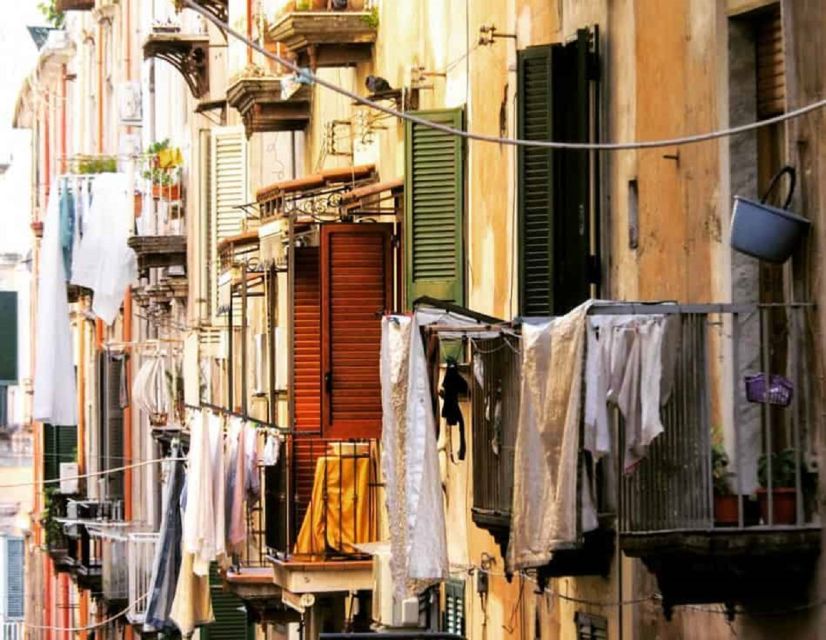
- See the Spanish Quarters from street level: Narrow lanes, stairways, laundry, and wall art show Naples in its most personal form.
- Follow the Maradona trail: The tour visits murals honoring the football hero adored across the city.
- Taste something at Pignasecca: Your food sample is sweet or savory, depending on what is available.
- Finish on Spaccanapoli: The route ends among major sights including Gesù Nuovo and Santa Chiara.
- Expect a small-group feel when numbers are low: One recent outing had only four people, while headsets are supplied from six participants onward.
Starting at Gran Caffè Gambrinus
The meeting point outside Gran Caffè Gambrinus puts you in the right mood immediately. This is not a random street corner. The café is one of Naples’ best-known literary meeting places and one of the city’s most elegant interiors, even if your tour begins outdoors.
From here, the guide moves through the monumental center. This opening section helps you place Naples on a map before the route turns into smaller lanes. You see the San Carlo Theatre, the Galleria Umberto, and Piazza Plebiscito, with the Royal Palace framing the square.
I like this beginning because it gives you Naples in two forms. First comes the polished, ceremonial city of theaters, royal buildings, and grand public spaces. Then the route shifts toward the crowded lanes where daily life takes over. That contrast is one of the most useful ideas a guide can offer in Naples.
The San Carlo Theatre brings a sense of scale and prestige. The Galleria Umberto offers a covered passage with a grand architectural feel. Piazza Plebiscito opens the view again after the tighter streets, and the Royal Palace adds a reminder that Naples was once a seat of royal power.
You will not spend hours inside these sites. This is an outdoor walking tour, so the value comes from seeing how these landmarks fit together. If you plan to visit the theatre, palace, or other interiors separately, this walk can help you decide what deserves more of your time.
More Farmers Market Tours in Italy
- Cooking Class and Lunch at a Tuscan Farmhouse with Local Market Tour from Florence
★ 5.0 · 4,831 reviews - Palermo: Street Food and Local Market Tasting Tour
★ 4.9 · 540 reviews - Pasta and Tiramisu Cooking Class with optional Local Market Tour
★ 5.0 · 515 reviews
Entering the Spanish Quarters
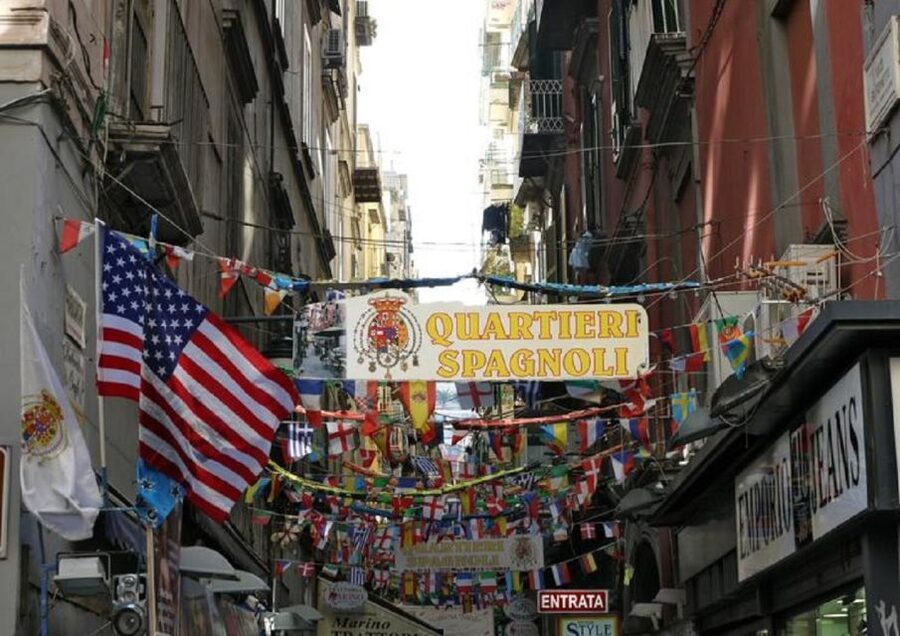
The Spanish Quarters are the heart of the experience. Their lanes climb the hill in a tight grid, crossed by stairways and narrow passages. Balconies carry hanging laundry, and buildings press close around the streets.
This is Naples without much polish. That is the point. You see apartments, shopfronts, shrines, wall paintings, scooters, and people going about ordinary business. The setting feels personal rather than arranged for sightseeing.
A guide matters here because the district can look like a maze. You can walk through it alone, but a good guide helps you notice the details instead of simply trying not to get lost. The route also gives context to the neighborhood’s layout and its place in the city.
The Spanish Quarters are densely populated, so you should expect tight walking space and a lot happening around you. Keep your group together and watch your step on uneven streets and stairs. The tour is only two hours, but the route is not a gentle stroll through a quiet park.
I especially like the visual details. Laundry stretched above your head makes the streets feel lived in. Street art appears on walls and building facades, often beside older layers of the city. Naples can look rough around the edges, yet that roughness is part of its character.
Finding the Maradona murals
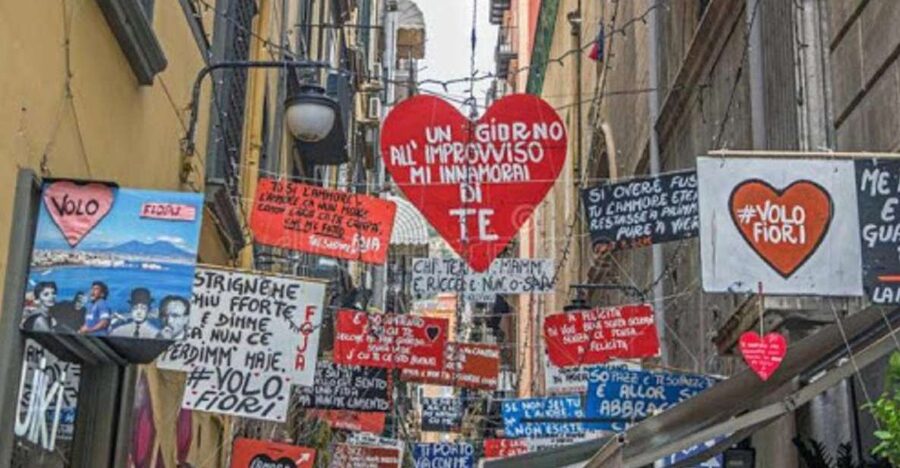
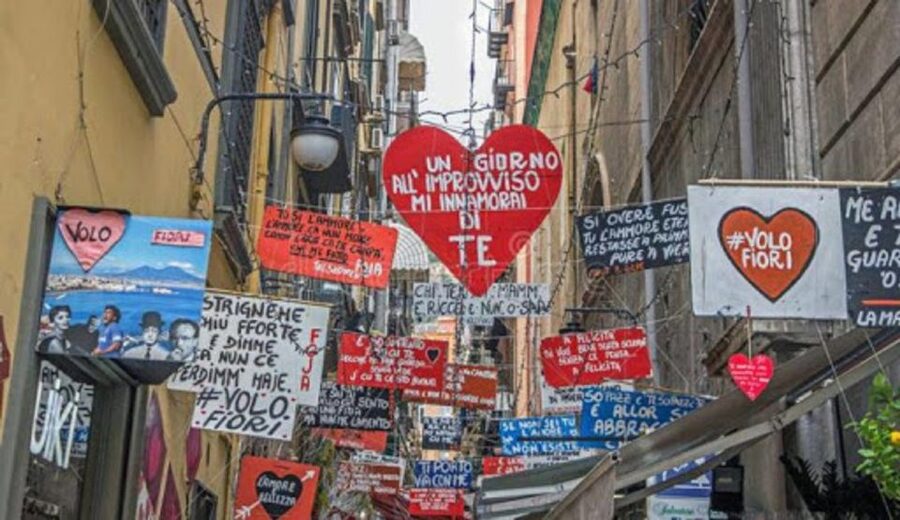
The Maradona stop gives the walk an emotional center. In Naples, Diego Maradona is remembered not only as a football star but also as a beloved champion and local idol. The murals connected to him have become some of the city’s best-known public images.
You visit the area associated with these paintings and hear about Maradona’s place in Neapolitan identity. This is more than a quick photograph beside a wall. The guide helps explain why football carries such weight here and why the murals mean so much to local people.
The stop suits football fans, but you do not need to follow the sport closely to enjoy it. It shows how a modern figure can become part of a neighborhood’s shared memory. The Spanish Quarters provide the setting, and the Maradona art gives the streets a clear voice.
Conditions around street art can change. Murals may be surrounded by other visitors, shops, or neighborhood activity, and you should not expect a formal gallery setting. The appeal is seeing the work where it belongs, among the streets and people that give it meaning.
Tasting Naples at Pignasecca Market
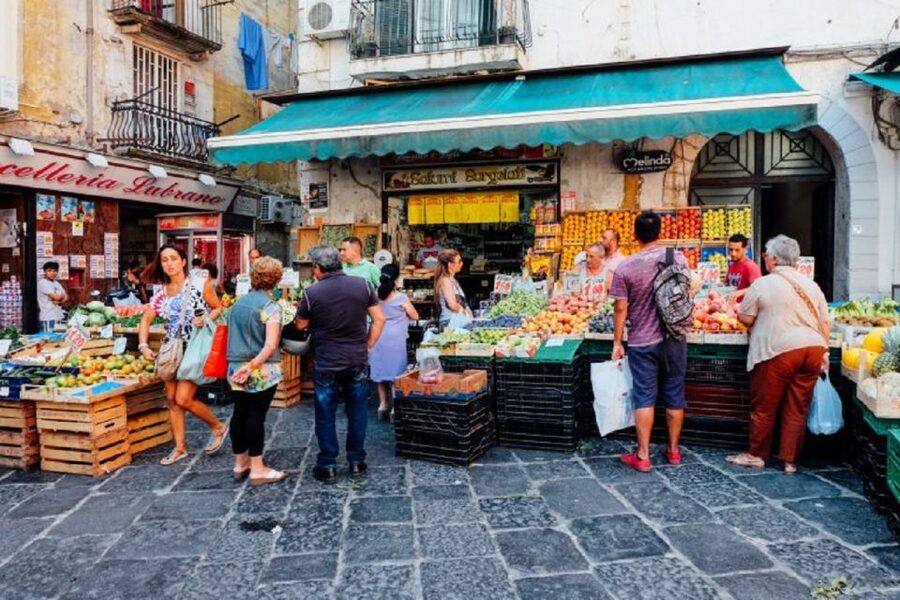
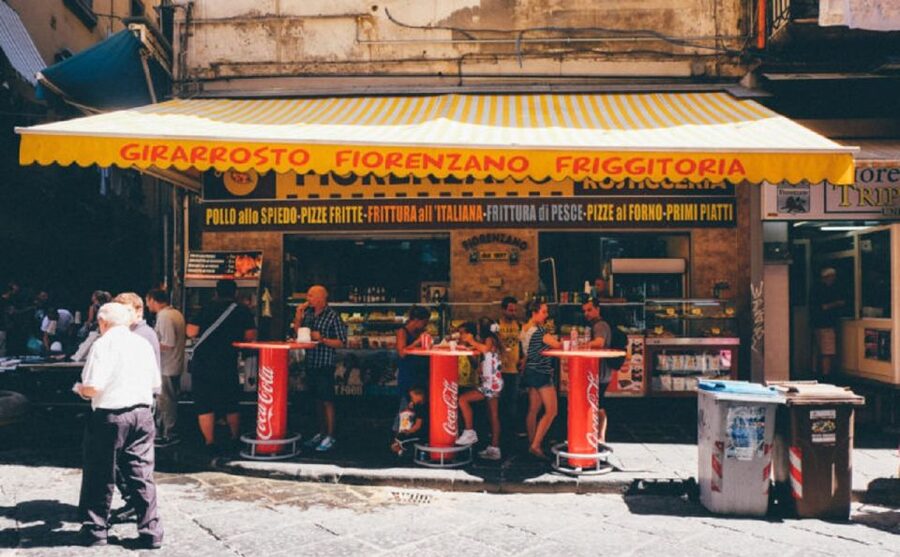
The route then reaches Pignasecca, a local market filled with food and clothing shops. This is the most useful stop for anyone who wants to understand Naples through its everyday shopping life rather than through monuments alone.
You take in the smells, colors, and noise of the market while the guide points out typical local food. A tasting is included, either sweet or savory. The exact item is not specified in advance, so think of it as a small local sample rather than a full meal.
That distinction matters. At $35 per person, the food tasting adds value, but it does not replace lunch. You are paying mainly for the guide and the route, with a modest taste of Naples included. If you arrive hungry, plan another meal before or after the tour.
Pignasecca also gives the walk a useful change of pace. The Spanish Quarters focus on lanes, murals, and neighborhood life. The market adds produce, food shops, clothing, and the practical business of buying and selling. You get a clearer sense of how the city works day to day.
I would not choose this tour only for the food. The tasting is one pleasant part of a broader city walk. If you want a dedicated food tour with several dishes, this experience may feel too limited. If you want one local bite woven into a history and street-art route, it fits well.
Same place, a different set of stalls:
- Rome: Colosseum, Roman Forum & Trajan’s Market Exterior Tour
★ 4.3 · 2,038 reviews - Taste of Testaccio: Special 15 Year Anniversary Edition
★ 5.0 · 1,658 reviews - Small Group Cooking Class & Market Food Tour in Florence
★ 5.0 · 1,574 reviews - Bologna Food & Market Tour with 6 Tastings, Pasta, Wines & More
★ 5.0 · 1,328 reviews
Finishing on Spaccanapoli
The final stretch reaches Spaccanapoli, the famous straight route through the old center. Its name refers to the way the street appears to split Naples in two. The route is one of the city’s most memorable places for a first orientation walk.
The tour includes the Church of Gesù Nuovo, the Obelisk of the Immaculate Conception, and the Basilica of Santa Chiara. These sights give the ending a strong architectural finish after the rawer feel of the Spanish Quarters and market.
The Church of Gesù Nuovo is especially striking from the outside, with its unusual stone facade. The obelisk adds a vertical focal point to the square, while Santa Chiara brings a calmer religious presence to the route. You see several major sights without having to cross the city by taxi or public transport.
This ending is practical. After the tour, you are already in one of Naples’ most central old-town areas. You can continue exploring on foot, stop for food, or return to a sight that caught your attention. The tour does not leave you at an isolated meeting point.
What the guide adds to the walk
A strong guide is the main reason to book this experience. The route itself is possible without paid help, and one less positive assessment made exactly that point. You can find the Spanish Quarters, Pignasecca, and Spaccanapoli by yourself.
The guide’s value comes from interpretation, pace, and local advice. Gianluca received especially warm praise for his humor, passion for Naples, and command of history and philosophy. He also gave practical advice about moving around the city and visiting Pizzeria Da Michele.
Other guides named in the feedback include Giorgia, Rosa, and Sara. Giorgia was praised for handling a small group of four with a friendly and professional manner. Rosa was credited with sharing characteristic places and anecdotes, while Sara made the walk interesting and enjoyable through her clear explanations.
Guide quality can vary from one departure to another, but the pattern is encouraging. The best experience here is not a list of dates and names. It is a conversation with someone who can explain why a mural matters, what makes a neighborhood distinctive, and how the grand center connects with ordinary street life.
From six participants onward, headsets are provided so you can hear the guide clearly. That is useful in narrow streets with traffic and market noise. For smaller groups, you may not need them, but the group size itself can make it easier to ask questions.
Is $35 a fair price?
At $35 per person, I consider this a fair price for a two-hour orientation walk, especially if you are new to Naples. You receive a live guide, a food tasting, and a route covering several different parts of the city.
The value depends on what you want. If you only need directions, you can walk these areas independently and save the money. If you want the history, neighborhood context, Maradona story, and market introduction explained as you go, the fee is easier to justify.
The tour also saves planning time. Instead of building a route between the monumental center, Spanish Quarters, Pignasecca, and Spaccanapoli, you follow one compact path. That can be useful on a short Naples visit.
You should think of it as a first look, not a complete city tour. Two hours is enough to see a lot, but not enough for extended interior visits or a long food stop. The experience works best early in your stay, when you can return later to the places that interest you most.
Who will enjoy this Naples walk?
I would recommend it to first-time visitors who want a fast but meaningful introduction to central Naples. It suits anyone interested in street art, local markets, urban history, football culture, and major landmarks.
It also works well for travelers who prefer walking over formal sightseeing. You are not moving from one museum room to another. You are watching the city unfold outdoors, with laundry overhead and market life at street level.
Families with older children may enjoy the variety. The route offers architecture, food, murals, and a famous football figure, so it does not depend on one subject alone. Still, the narrow streets and stairs may require attention, and the walk takes place in all weather.
History fans should keep their expectations in check. The guides can add history, philosophy, and local stories, but this is not a specialist lecture. Art lovers may also want more detail about individual works, since the street art appears as part of a wider neighborhood tour.
Practical advice for the two-hour route
Wear comfortable shoes. The route includes narrow lanes, old streets, and stairs in the Spanish Quarters, so this is not the place for delicate footwear.
Bring weather protection. The tour runs rain or shine, and much of the experience takes place outdoors. A wet walk through the market and old streets can still be worthwhile, but you will enjoy it more if you are prepared.
Do not plan a large meal during the tour. The included tasting is either sweet or savory, and the market stop is designed for a sample and an introduction rather than a long restaurant break.
Arrive at Gran Caffè Gambrinus with enough time to find the meeting point outside. The café is an easy landmark in the monumental center, but the streets around it can feel busy and confusing if you are rushing.
The tour is available in Italian and English. Free cancellation is offered up to 24 hours before the start, and you can reserve now and pay later, which helps if your Naples plans are still changing.
Should you book this tour?
Book it if you want a well-priced first walk through Naples that mixes grand sights with ordinary neighborhoods. The route is strongest when the guide connects the San Carlo Theatre and Royal Palace with laundry-lined lanes, Maradona murals, Pignasecca shops, and the churches of Spaccanapoli.
Skip it if you prefer exploring alone, already know these districts, or want a full food tour. The one clear criticism is that the route can be followed independently, and that is fair. You are paying for the stories, local perspective, pacing, and practical advice.
For most first-time visitors, I think the $35 fee is sensible. Choose it near the start of your stay, listen closely to the guide, and use the final stop on Spaccanapoli as a launch point for your own further exploring.
FAQ
Where does the tour meet?
The tour meets outside Gran Caffè Gambrinus in Naples.
How long does the tour last?
The walking tour lasts two hours.
What languages are available?
The tour is available in Italian and English.
What sights are included?
The route includes the San Carlo Theatre, Galleria Umberto, Piazza Plebiscito, the Royal Palace area, the Spanish Quarters, Pignasecca market, Spaccanapoli, Gesù Nuovo, the Obelisk of the Immaculate Conception, and Santa Chiara.
Is food included?
Yes. One sweet or savory food tasting is included.
Are headsets provided?
Headsets are provided when the group has six or more participants.
Does the tour visit Maradona murals?
Yes. The route includes street art connected with Maradona, the famous football champion and Neapolitan idol.
Does the tour run in bad weather?
Yes. The tour takes place rain or shine.
Can I cancel for a full refund?
Yes. You can cancel up to 24 hours in advance for a full refund.
More Street Art Walks in Italy
- The Spanish Quarters, Street Art and Local Market Tour in Naples
★ 5.0 · 23 reviews - 2-Hour Food, History and Street Art Tour of Ponce City Market
★ 5.0 · 159 reviews - Phnom Penh’s Morning Market and Street Art Tour by Tuk tuk
★ 5.0 · 128 reviews - Cancun Walking Food Tour: Local Food, Markets, and Street Art.
★ 5.0 · 49 reviews
Just added around Italy
- Cesarine: Market Tour & Home Cooking Class in Catania★ 4.0 · 6 reviews
- Small Group Market tour and Dining Experience at a Cesarina’s home in Brindisi★ 4.5 · 6 reviews
- Small Group Market tour and Cooking class in Brindisi★ 4.5 · 8 reviews
- Cesarine: Market Tour & Cooking Class at Local’s Home in Bologna★ 5.0 · 19 reviews
- Private Market Tour and Cooking Class in Bologna with Giovanna C★ 5.0 · 20 reviews
- One day tour Christmas markets Innsbruck – Bressanone – Vipiteno★ 4.5 · 11 reviews
- Food markets tour with a local!★ 4.5 · 39 reviews
- Cesarine: Market Tour & Home Cooking Class in Bari★ 5.0 · 5 reviews
Local & Farmers Market Tours, compared.
Hanoi Cooking Class: Culture, Local Market & Meaning CSR Impact
Read our review →
Cooking Class and Lunch at a Tuscan Farmhouse with Local Market Tour from Florence
Read our review →
Cooking Class Hoi An:Local Market, Basket Boat, Fishing & Cooking
Read our review →
London Bridge & Borough Market Food Tour with 7 Authentic Dishes
Read our review →
Hoi An Cooking Class(Local market,Basket Boat,Fishing & Cooking)
Read our review →
Browse the lists this tour appears in