
Review · MOROCCO
Evening Marrakech: Gastronomic and Market Tour Inside the Medina
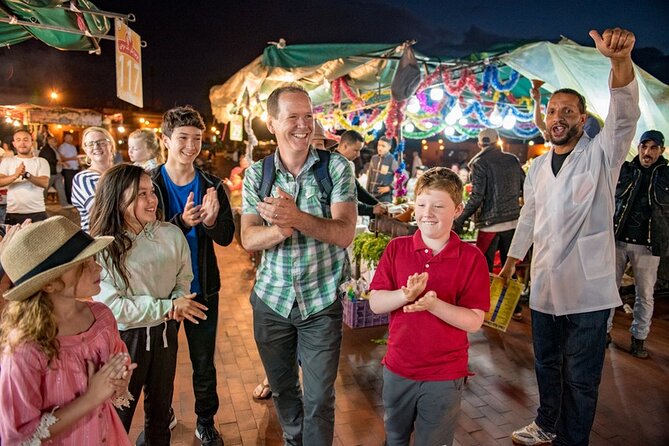
Marrakech eats best after sunset. This 3.5-hour walk pairs market tastings and spice talk with dinner in Djemaa El Fna, giving you a useful first look at the medina’s food culture. I like the small maximum of 12 people, and I like that guides such as Atika, Brahim, Ibrahim, Jihad, and Yousif have helped make the tour feel personal and easy to follow.
The route reaches food stalls and shops that can be hard to find alone, from the Mellah spice market to a meat alley serving mechoui and tangia. The main caution is consistency: some people have found the food excellent and safe, while others felt portions were small or questioned cleanliness, so this is better for adventurous eaters than cautious diners.
Key things to know before you book
- Snail soup is part of the tasting: Ghoulal, a herbal and spicy Moroccan snail soup, is one of the tour’s more unusual samples.
- Dinner happens in Djemaa El Fna: You eat as the square fills with food stalls, entertainers, snake charmers, and evening crowds.
- The group is capped at 12: That is small enough for questions and personal food guidance, though a private booking may suit you better if dietary needs are important.
- The tour visits working food markets: You see meat sellers bargain with local buyers, rather than simply walking past polished tourist shops.
- The cost is $46.08 per person: The value comes from the tastings, guide, orientation, and included meal, not from a large restaurant feast.
- Vegetarian and vegan needs can be handled: Send requests at least 24 hours ahead. Gluten intolerance cannot be accommodated.
Why this evening tour works best on your first night
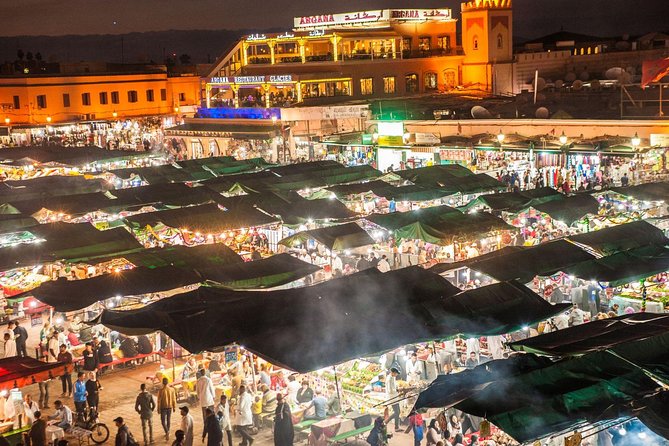
The central square can feel like a lot when you first arrive. Djemaa El Fna is wide, noisy, crowded, and full of competing smells and offers. Meeting at the Hôtel Restaurant Café de France at 6:00 p.m. gives you a fixed point in the middle of it all, then a local guide helps you read the scene.
I like this as an early-Marrakech activity because it does more than feed you. You learn how the medina is arranged, where the souks lead, how locals shop for meat, and how Moroccan cooks use spices. Several guides have been praised for helping first-time visitors get their bearings, especially Atika, Brahim, Ibrahim, Mustafa, Yousif, and Jihad.
The tour ends back at the meeting point, so you can return to your hotel or keep exploring Djemaa El Fna on your own. The route is on foot, and the medina’s narrow lanes can be busy, uneven, and crowded. Wear comfortable shoes and keep your belongings secure without letting that distract you from the food.
More Evening Experiences in Marrakech:
- Bangkok by Night: Temples, Markets and Food Tuk-Tuk Tour
★ 5.0 · 3,752 reviews - Phuket: Full Day City Tour with Night Market
★ 4.5 · 2,888 reviews - Bangkok: Markets, Temples and Food Night Tour by Tuk Tuk
★ 4.9 · 2,371 reviews
Djemaa El Fna at 6:00 p.m.
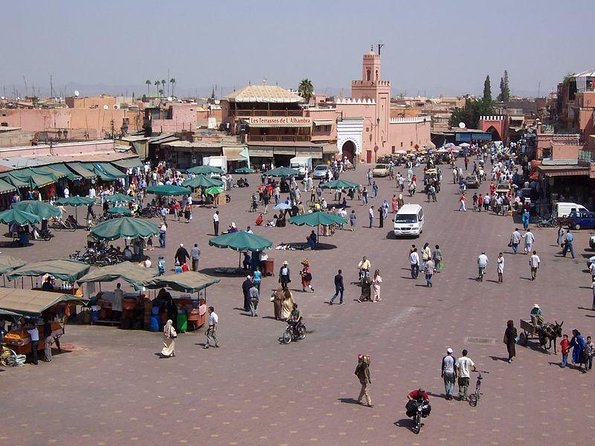
Your first stop is Djemaa El Fna, Marrakech’s famous main square. It is recognized as a UNESCO World Heritage site, and evening is when its food stands, lights, performers, and crowds begin to gather in force.
The opening 15 minutes are less about eating and more about taking in the setting. Storytellers, dancers, water sellers, snake charmers, and food vendors all compete for attention. A guide gives this commotion some shape, explaining what you are seeing and helping you avoid wandering into the square without a plan.
This is also where the tour’s social side begins. If your group is full, you may share tastings and conversation with up to 11 other people. If the group is very small, you can ask more questions and may receive more personal attention. One booking was described as a one-on-one experience, with the guide adapting the food to the participant’s needs.
Do not expect a quiet dinner setting at the start. Djemaa El Fna is the show, and the meal later keeps you in the middle of it.
Riad Zitoun Jdid and the streets beyond the square
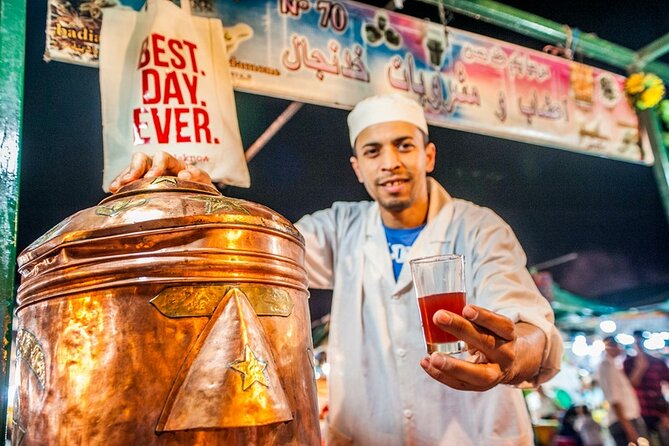
The route continues through Riad Zitoun Jdid, an area known for former grand homes converted into riads, small bistros, hammams, and shops. Rooftop terraces serve mint tea and Moroccan-influenced European food, while nearby stores sell pottery, kaftans, and leather bags.
You may also hear about the Bahia Palace and Dar Si Siad Museum in this area. The tour does not present these as major museum visits, so think of this section as cultural context while walking between food stops. It helps connect Moroccan cuisine with the homes, crafts, clothing, and daily life of the old city.
This part lasts about 15 minutes. That is enough to get a feel for the neighborhood, but not enough for a full sightseeing visit. If Bahia Palace or the museum is high on your list, plan to return separately.
The Mellah spice market and meat stalls
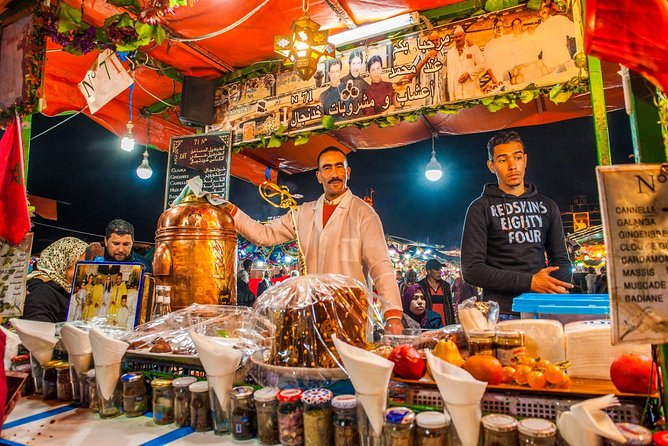
The 45-minute stop in Mellah is one of the most useful parts of the evening. This former Jewish quarter has narrow lanes, the Lazama Synagogue, the Miaara Jewish cemetery, a produce and meat market, and the Bab Mellah Spice Souk.
Here you see food shopping as a daily task, not just a display for visitors. The guide explains how buyers and sellers bargain over poultry and beef, and you watch those deals take place. Haggling is part of ordinary Moroccan commerce, so this scene gives you a better sense of how the city works than a quick pass through a souvenir market.
The spice section brings color and scent to the walk. Saffron, paprika, cardamom, anise, turmeric, and cumin are discussed in practical terms, including how they flavor tagines and other Moroccan staples. I particularly like this part because it answers the question many people have after eating Moroccan food: what creates that layered flavor?
You are not simply shown jars and told their names. The guide connects the spices to cooking, trade, and the food you are about to taste. Morocco’s location made it an important center for spice trading, and that background gives the market more meaning.
A few more market tours around Marrakech worth a look
- Marrakech: Bahia Palace, Saadian Tombs, Souk and Medina Tour
★ 4.7 · 4,974 reviews - Marrakech: Ben Youssef, Secret Garden, & Souks Walking Tour
★ 4.6 · 2,802 reviews - Marrakech: Colorful Medina Souks Guided Walking Tour
★ 4.7 · 2,470 reviews - Marrakech: Traditional Moroccan Cooking Class & Market Visit
★ 4.8 · 1,861 reviews
Mechoui Alley and a very Moroccan dinner
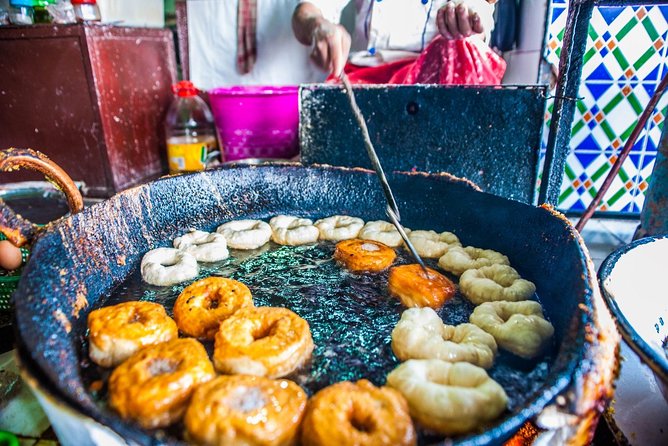
The longest food stop is at Chez Lamine Hadj Mustapha near Djemaa El Fna. The stand sits in what is described as Mechoui Alley, behind the Alhambra restaurant. Sheep’s heads and tangia cooking pots make the place easy to recognize, though not necessarily easy for every diner to embrace.
Mechoui is slow-roasted sheep, while tangia is a meat dish cooked in a clay pot. The pots are cooked in the ashes of coals from a local bathhouse, and the juices at the bottom are eaten with Moroccan bread. That detail alone shows why this tour is different from a standard restaurant meal. You are seeing a local cooking method in the place where it is prepared.
The route may include challenging foods such as sheep’s head, cow’s hoof, or snail soup. You are not required to enjoy every item, but you should be open to trying at least a taste. The tour’s strongest moments come when you treat unfamiliar food as a cultural lesson, not as a test of bravery.
Food portions deserve realistic expectations. The included meal and three typical market tastings create a full sampling experience, but this is not necessarily a large multi-course dinner. One poor account described a very small shared portion, while other accounts praised the variety and said the meal was good. That suggests you should book this for range and access, not for a lavish feast.
Ghoulal, snacks, and the value of eating small bites
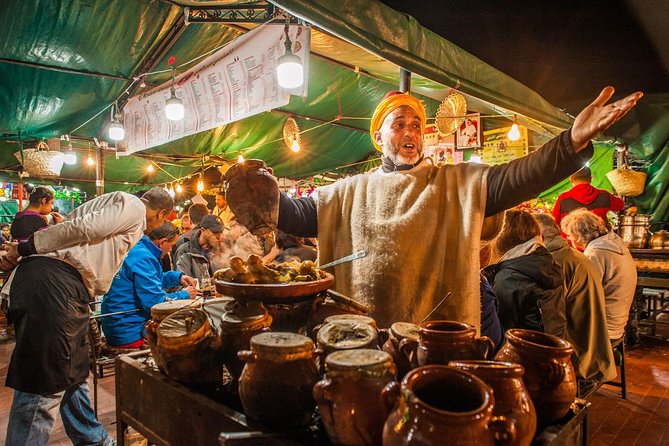
Ghoulal, or Moroccan snail soup, is the signature challenge. It is served with herbs and spices, and its appeal is as much cultural as culinary. If you already know you dislike snails, you can still ask about the broth and try only what feels comfortable.
Other possible tastings include nuts, olives, pastries, harira soup, spiced sardines, and additional local specialties. The exact mix may depend on the stalls operating that evening and the needs of the group. A guide named Jihad received praise for adapting a one-person tour to dietary requirements and serving foods such as harira, sardines, and pastries.
This flexibility is useful, but it has limits. Vegetarian and vegan requests can be handled if you give at least 24 hours’ notice. Gluten intolerance cannot be accommodated, so this is not a good choice if avoiding gluten is essential.
Food safety also deserves a plain warning. Some people have reported no trouble and specifically said the street food was fine, while one account described illness after a cold soup and raised concerns about hygiene. That does not prove a general problem, but it does mean you should use your own judgment, avoid anything that looks poorly handled, and tell the guide about concerns before you eat.
Souk Semmarine after dark
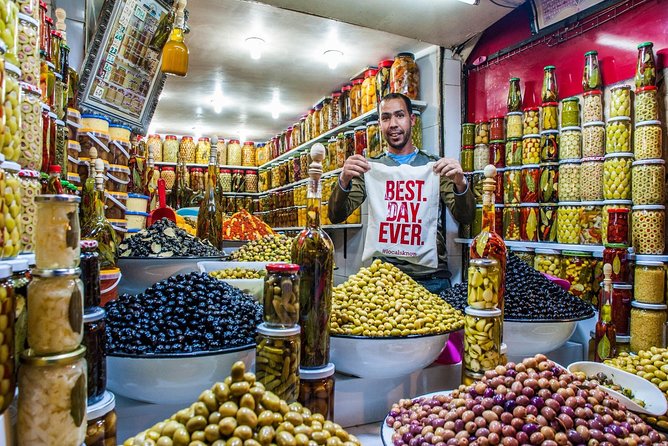
Souk Semmarine is the main artery of the Medina’s souks. It begins near Djemaa El Fna and runs through a narrow alley once associated with farriers who shod the animals of passing caravans.
The one-hour walk gives you time to see the souk as a working shopping district rather than a single attraction. Stalls and lanes can feel confusing, especially after dark, and this is where a local guide earns much of the tour price. You can ask how to return to a shop, where to find food, and how to move through the area without stopping in the middle of the flow.
The tour provides practical tips about souks and eateries. That may be more valuable than another plate of food, particularly if you are staying in Marrakech for several days. Several people found the walk helped them feel confident enough to return to the Medina independently.
Still, do not expect a quiet, carefully staged food crawl. The square and souks are crowded, sellers are active, and the route can change pace as the group stops to taste, watch, and ask questions.
Dinner with the square as your backdrop
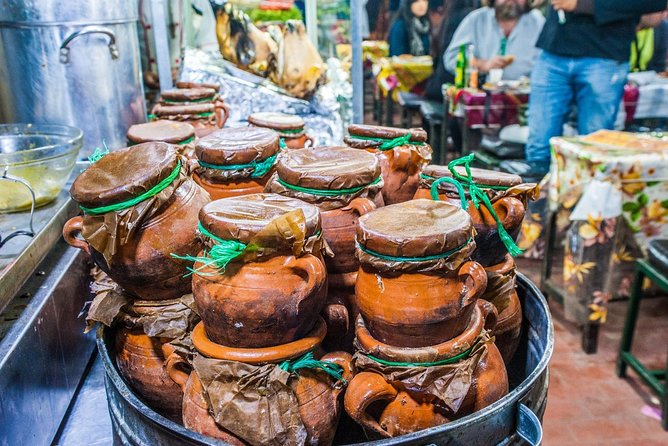
The evening ends with an authentic Moroccan dinner near Djemaa El Fna. You eat while the square reaches its nightly peak, surrounded by peddlers, entertainers, snake charmers, lights, smoke, and constant movement.
This setting is the tour’s biggest selling point. A restaurant meal can give you good food, but it cannot reproduce the feeling of eating beside one of Morocco’s most famous public spaces at the busiest time of day. If you enjoy atmosphere more than table service, this should be memorable.
The tradeoff is comfort. Noise, crowds, and basic food service are part of the deal. The experience may feel less polished than a riad dinner, and the quality can depend on the particular stop and guide. A few people found the tour too basic for the price, while others called it excellent value because it included an approachable guide, many tastings, and a full evening in the Medina.
What $46.08 buys you
At $46.08 per person, the price is reasonable if you value orientation and access. You receive a 3.5-hour guided walk, three market tastings, an included local dinner, spice explanations, and help navigating areas that can be confusing on your own.
The price is less attractive if you mainly want a large meal. Additional food is not included, and you may want to buy extra snacks, drinks, or spices during the walk. Group discounts may also be available, but the exact saving depends on the booking.
I would compare this cost with what you might spend on several small food purchases plus a restaurant meal. The tour’s added value is the route, the explanations, and the chance to watch local buying and cooking practices. It is not simply paying for dinner.
The carbon-neutral operation and eco-certified provider may matter to you, especially if you are trying to choose lower-impact activities. The walk also uses no sightseeing vehicle, though hotel pickup and drop-off are not included.
Who should book this Marrakech food walk?
I would choose this tour for a first visit, especially on the first or second evening. It gives you a map in your head, introduces the food customs of the Medina, and makes the central square less intimidating.
It suits people who enjoy:
- Trying unfamiliar foods in small portions
- Walking through crowded markets
- Asking questions about spices and local cooking
- Eating in a lively public setting
- Learning practical ways to navigate the souks
Families can join, and children under six are admitted free. The route is also suitable for most participants, but young children may not enjoy the noise, crowds, or unusual foods as much as older children and adults.
If you want detailed personal attention, consider asking about a private option. The standard group is limited to 12, which is a good size, but private tours have allowed guides to adapt the menu more closely to individual needs.
Should you book it?
Book it if you want a lively introduction to Marrakech’s food culture, not a polished fine-dining evening. The strongest reasons are the spice market, the working meat stalls, the unusual tastings, and dinner in Djemaa El Fna.
I would be cautious if you have strict dietary limits, expect generous restaurant portions, or dislike basic market conditions. Vegetarian and vegan requests are possible with advance notice, but gluten intolerance cannot be handled.
The guide makes a major difference. Atika, Brahim, Ibrahim, Jihad, Mustafa, and Yousif have each been praised for warmth, clear explanations, and practical help, while a few poor experiences involved a guide who seemed disengaged or hard to identify at the start. Confirm the meeting details carefully, arrive at Café de France before 6:00 p.m., and give the guide your food requirements early.
For most first-time visitors who want to get their bearings while eating something unusual, this is a worthwhile evening. Just bring curiosity, comfortable shoes, and sensible expectations about street food.
FAQ
How long does the Marrakech food tour last?
The tour lasts approximately 3 hours and 30 minutes, beginning at 6:00 p.m.
Where does the tour begin?
It begins at Hôtel Restaurant Café de France, at Djemaa El Fna on Rue des Banques in Marrakech.
Where does the tour end?
The activity ends back at the meeting point in Djemaa El Fna.
Is dinner included?
Yes. The tour includes an authentic local dinner and three typical market tastings. Additional food is not included.
Can vegetarians and vegans join?
Yes. The tour can cater to vegetarian and vegan diets if you provide the request at least 24 hours before the start time.
Can the tour accommodate gluten intolerance?
No. Gluten intolerance cannot be accommodated on this tour.
What is the cancellation policy?
You can cancel at least 24 hours before the start time for a full refund. Cancellations or changes made within 24 hours are not refunded.
Just added around Marrakech
- Souks tour of Marrakech ( 3 hours )★ 5.0 · 5 reviews
- Marrakech: Hidden Souks Shopping Tour with Private Guide★ 4.1 · 53 reviews
- Marrakech: Half-Day Medina Markets Tour★ 4.5 · 11 reviews
- Edgy 8 Dish Private, Fusion Cooking Class, Menu Plan, Market★ 4.9 · 31 reviews
- Marrakesh: Private Cooking Class & Local Market Shopping★ 4.7 · 15 reviews
- Marrakech: Bahia Palace, Madrassa & Souks Guided Tour★ 4.8 · 47 reviews
- Marrakech: Vibrant Souks, Local Artisans & Medina Experience★ 4.5 · 66 reviews
- Marrakech: Private Souks Tour with Tea and Traditional Snack★ 4.6 · 33 reviews
Market Tours, compared.
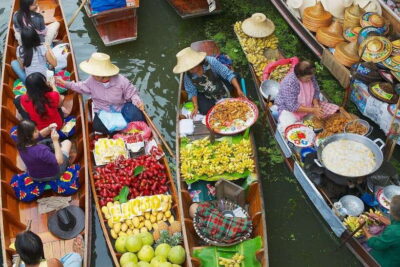
Damnoen Saduak Market and Maeklong Railway Market
Read our review →
The Old Siam: Damnoen Saduak and Maeklong Railway Market
Read our review →
Old Town, Creek, Museums, Souks, & Street Food Tour
Read our review →Train Market & Floating Market with Boat Ride
Read our review →
Old Town, Souks, Street Food, Guided Tour & Abra Ride
Read our review →
Ayutthaya & Ayothaya Floating Market Day Trip
Read our review →
Frame Tickets, Creek, Souks & Blue Mosque Guided Tour
Read our review →
Hanoi Cooking Class: Culture, Local Market & Meaning CSR Impact
Read our review →Browse the lists this tour appears in