
Review · THAILAND
Damnoen Saduak Famous Floating Market and Mea Klong Railway Tour
The train comes through the market. That is the hook here: you travel from Bangkok to see Mae Klong Railway Market fold away its awnings and goods as a train passes, then return them moments later. I like the tour’s two very different markets and the added coconut sugar farm visit. I also like that a boat trip and air-conditioned transport are included.
The main drawback is the travel time. You spend about 90 minutes each way on the road, and the full outing lasts around six hours. The group may reach 60 people, so this suits you best if you value convenience and a packed day over a small, quiet outing.
Key points to know before booking
- Mae Klong’s train passage is the day’s most unusual sight: Market stalls sit directly beside an active railway.
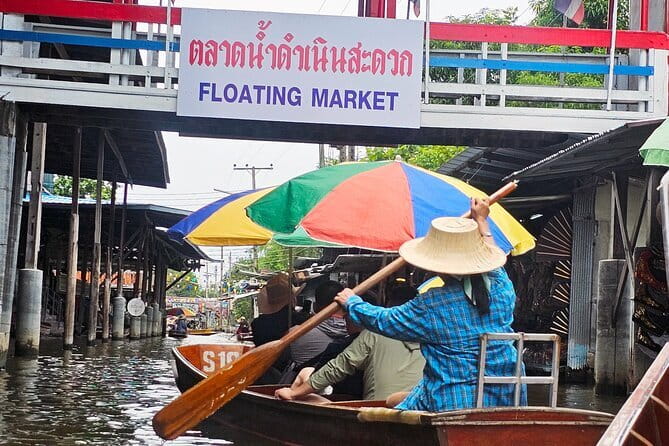
- Damnoen Saduak includes a teakwood boat ride: You enter the waterways and reach the center of the floating market.
- The coconut sugar farm adds local context: You see how a traditional product is made and may sample fresh coconut milk.
- Air-conditioned transport covers the long road journey: The tour travels roughly 96 kilometers from Bangkok.
- Elena and Tooky received especially warm praise: Both guides were described as friendly, helpful, and good fun.
- Lunch is not included: Bring money for food and personal purchases at the local market.
Two famous markets in one long Bangkok day
This tour gives you a quick look at two places that are often treated as separate day trips. Mae Klong Railway Market is built along the tracks in Samut Songkhram Province. Damnoen Saduak is a canal market known for boats, local goods, and traditional trading.
That combination is the tour’s greatest strength. The railway market is about timing and spectacle. The floating market is about movement, waterways, local commerce, and the experience of seeing a market from a boat. You get two distinct settings rather than spending the whole morning in one place.
The tour begins at Pak Khlong Talat, Bangkok’s flower market area, near Wat Kalayanamitr. It ends at the same meeting point. You should pay close attention to the meeting instructions, since standard hotel pickup is not included. A hotel pickup option may be available when booking, but you should check exactly what you select before paying.
The total price is listed at $61.33 per person. That is not the cheapest way to reach either market, especially if you are comfortable arranging transport yourself. Still, the price includes roundtrip air-conditioned transportation, a local guide, a bottle of water, and the boat trip. For a first visit to Bangkok, I think the convenience can justify the cost, particularly when you consider the distance and the number of stops.
More Floating Market Tours in Bangkok
- Bangkok: Damnoen Saduak Market and Maeklong Railway Market
★ 4.5 · 26,723 reviews - The Old Siam: Damnoen Saduak and Maeklong Railway Market
★ 4.5 · 10,992 reviews - Bangkok: Train Market & Floating Market with Boat Ride
★ 4.7 · 9,547 reviews
The 90-minute ride to Samut Songkhram
The first leg takes about an hour and a half. The road distance is roughly 96 kilometers from Bangkok, so this is not a quick hop outside the city. Air conditioning matters in Thailand, especially when you are spending much of the day outdoors and around open-air markets.
The journey is also the main practical weakness. The tour description advises against joining if you suffer from car sickness, since the ride takes about 90 minutes each way. If that is a concern, carry whatever usual remedy works for you and choose a seat that helps you feel comfortable.
The drive gives your guide time to explain the day’s stops and local customs, though the amount of commentary may depend on the group and traffic. Since the group can include up to 60 people, do not expect the intimacy of a private tour. The advantage is that you do not need to arrange taxis, negotiate multiple fares, or work out the route between the railway and canal markets.
Mae Klong Railway Market and the passing train
Mae Klong Railway Market is also called Rom Hoop Market. The name refers to the way awnings are pulled back when a train approaches. The market extends for about 100 meters beside the railway near Mae Klong Station.
You find ordinary market goods here: seafood, vegetables, fruit, fresh and dried food, meat, and miscellaneous items. That matters because the market is not simply a staged photo stop. It functions as a local fresh market, even though its position beside the railway has made it famous.
The key moment is the train passing through. As it approaches, sellers move goods and awnings away from the track. Once the train has gone, the market returns to its former shape with remarkable speed. This is the kind of practical, slightly strange sight that makes a day trip worthwhile. The railway is not a backdrop. It cuts right through the market’s daily working space.
You should follow your guide closely here. One of the strongest comments about the tour described the railway visit as exciting and credited Elena with escorting the group well. The area can feel tight, and the railway is active, so this is not the place to wander off while watching the train. The guide’s role is useful not just for explanation but also for helping you understand where to stand and when to move.
The stop lasts about an hour, though the exact amount of time devoted to the train will depend on the schedule. The supplied details do not give a precise train arrival time, so you should not assume you can arrive independently and see the same passage. Joining the organized visit gives you a better chance of being in the right place at the right time.
This market is best for you if you enjoy everyday places with an unusual twist. It is less suited to anyone expecting a polished attraction with wide walkways and plenty of personal space. The appeal comes from seeing an active market adapt to an active railway.
A short stop at the coconut sugar farm
After the railway market, the tour spends about 30 minutes at a local coconut sugar farm and factory house. You learn how coconut sugar is made and see something of the local way of life.
This stop is brief, but it gives the day a useful change of pace. At the railway market, the main subject is the train. At the farm, the focus shifts to food production and household-scale work. You get a little more context for the products sold in the markets instead of seeing them only as items on a stall.
Elena’s tour included fresh coconut milk, an unexpected treat that added to the stop. That detail may not be guaranteed on every departure, but it shows the sort of personal touch that can make a local guide valuable. Tooky also received especially warm praise for being friendly and good fun, with the overall experience described as feeling like a local family-style outing.
Do not expect a long farm visit or a full agricultural tour. Thirty minutes is enough for an introduction, not a detailed workshop. I would treat it as a pleasant cultural stop that breaks up the drive and connects the markets to local production.
More Floating Market Tours in Thailand
- Half-Day Railway Market and Floating Market Tour in Thailand
★ 4.5 · 3,924 reviews - Bangkok: Damnoen Saduak, Train Market & Mahanakhon Day Trip
★ 4.7 · 2,162 reviews - From Bangkok: Damnoen Saduak Floating Market Guided Tour
★ 4.4 · 2,020 reviews - Damnoen Saduak Floating Market and Maeklong Railway Market Tour
★ 4.5 · 1,588 reviews
Damnoen Saduak by teakwood boat
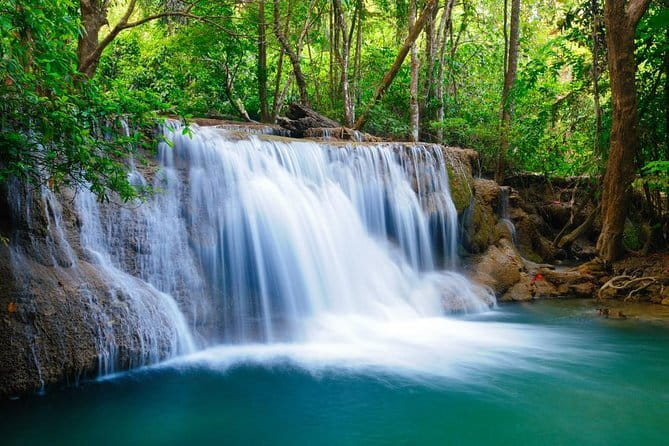
Damnoen Saduak is the tour’s longer market visit, with about 90 minutes scheduled there. It is presented as a market tradition dating back around 100 years, and its canals are the reason it is often associated with the nickname Venice of Southeast Asia.
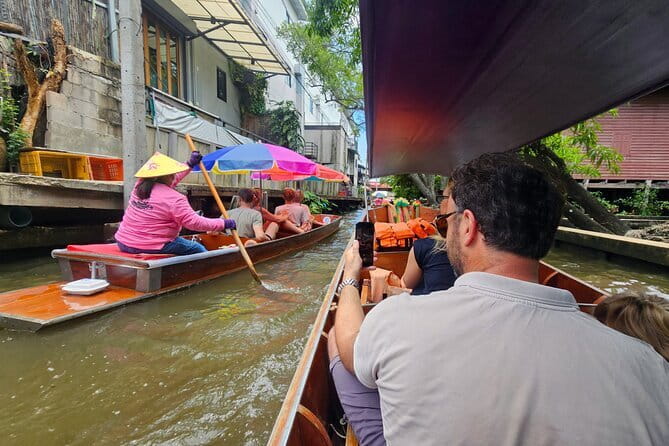
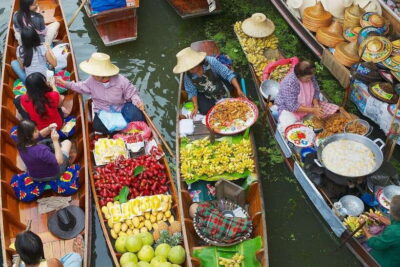
The included boat trip is important. You do not simply walk along the edge and photograph the water. You ride a teakwood boat toward the center of the floating market, seeing the stalls and waterways from the same level as the sellers. That changes the experience. The market becomes a route through canals rather than a row of shops.
The boat ride is included in the tour price, which improves the value. At many famous markets, transport on the water becomes an extra charge that you must sort out after arriving. Here, it is part of the plan.
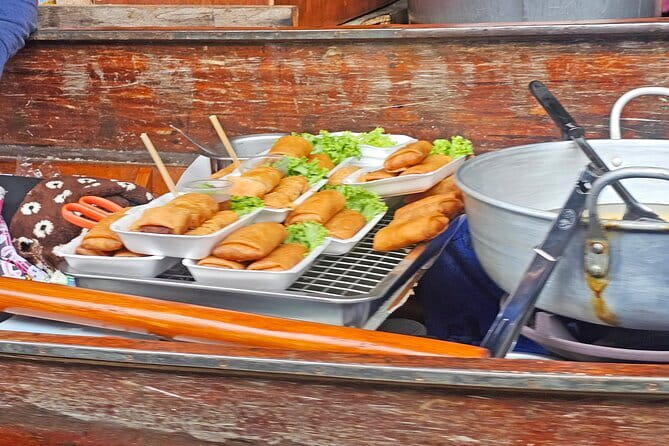
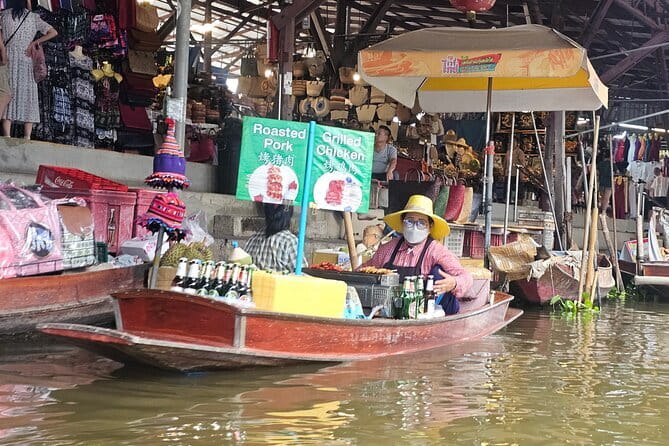
The market is a lively place to look at local products, food, and small goods. You may find vendors selling from boats, while other sellers work from the canal edges. The information provided does not promise a fixed list of products, so go with curiosity rather than a precise shopping plan.
The canals and boats are the main attraction, but this is also the stop where commercial pressure may feel strongest. You are visiting a famous market, not a quiet village waterway. If you want to buy something, compare prices and remember that personal expenses are not included.
Lunch is also not included. The schedule allows time for lunch at the local market, but you pay separately. This gives you freedom to choose what appeals to you, though it means you should carry Thai baht or another accepted payment method. The tour details do not specify a restaurant or a set meal, so plan for a casual local-market lunch rather than a formal dining stop.
The floating market suits you if you want a visual, active introduction to canal life. The boat trip is likely to be the most enjoyable part for many people, especially if you like seeing places from the water. It may disappoint you if you expect an untouched or purely traditional setting, since its fame has made it a major visitor attraction.
What the guides add to the day
A good guide matters on this excursion because the stops are spread out and the railway market requires careful timing. The strongest personal praise went to Elena and Tooky.
Elena was described as friendly and informative, with particular credit for explaining the floating market, the homes along the waterways, and the coconut farm. Tooky was praised as friendly, entertaining, and helpful during a combined railway and floating-market visit.
Those details suggest the tour works best when you engage with the guide rather than treating the day as a series of photo stops. Ask questions about the market goods, the coconut sugar process, and how the railway affects the sellers. The exact guide is not guaranteed, so you should not book solely on the expectation of having Elena or Tooky. Still, the guide quality is one of the experience’s most praised features.
The maximum group size of 60 is worth keeping in mind. With a group that large, instructions may need to be clear and repeated, and moving through the market may take patience. If you prefer quiet conversation and flexible timing, a private or smaller option would probably suit you better. If you want an organized route at a known price, the group format is practical.
Price, timing, and what you actually receive
At $61.33 per person, the tour offers solid convenience rather than bargain-basement transport. You receive roundtrip air-conditioned transportation, a local guide, bottled water, and the Damnoen Saduak boat trip. The two major markets and the coconut sugar stop are all included without separate admission charges.
You still need money for lunch, souvenirs, and other personal expenses. Tips are optional. Hotel pickup is not part of the standard arrangement, and the activity begins and ends at Pak Khlong Talat.
The schedule adds up to about six hours:
- About 90 minutes from Bangkok to Samut Songkhram
- About one hour at Mae Klong Railway Market
- About 30 minutes at the coconut sugar farm
- About 90 minutes at Damnoen Saduak
- About 90 minutes returning to Bangkok
Traffic can affect the actual timing. The schedule is full, so you should not book another fixed activity immediately afterward. The return is to the original meeting point, not to a different hotel or neighborhood.
Free cancellation is available if you cancel at least 24 hours before the experience starts. Cancellations made less than 24 hours ahead are not refunded, and late changes are not accepted. That rule is simple, but you should note the local-time cutoff.
Who should book this experience

I would recommend this tour to a first-time Bangkok visitor who wants to see two well-known markets in one day without arranging several transfers. It also suits you if you enjoy unusual local sights, short cultural stops, and a guide who can explain what you are seeing.
Families and mixed-age groups may appreciate the air-conditioned vehicle and straightforward schedule, though the long drive and market crowds can be tiring. Most people can participate, according to the activity details, but anyone prone to car sickness should think carefully about the two 90-minute road journeys.
I would be more cautious if you want a slow, independent market visit. The group may be large, lunch is not arranged, and each stop has a set time. You will see a lot, but you will not have unlimited time to browse or linger.
Should you book the railway and floating-market tour?
Book it if you want a convenient, well-filled day with two very different Thai markets. The train passing through Mae Klong is the strongest reason to go, while the included teakwood boat ride gives Damnoen Saduak real value. The coconut sugar farm and warm guide reports from Elena and Tooky add useful local color.
Skip it if long road journeys make you uncomfortable, or if a group of up to 60 feels too large. You should also budget separately for lunch and shopping. For the right kind of visitor, this is an efficient way to get beyond central Bangkok and see places that are difficult to combine on your own.
FAQ
Where does the tour begin and end?
It begins at Pak Khlong Talat, the flower market area near Wat Kalayanamitr in Bangkok. The activity ends back at the same meeting point.
How long does the experience last?
The tour lasts approximately six hours, including travel from Bangkok to the markets and the return journey.
Is hotel pickup included?
Standard hotel pickup is not included. A hotel pickup option may be available when booking, so check the selected option carefully.
Is the boat ride included in the price?
Yes. The tour includes a boat trip at Damnoen Saduak Floating Market, using a teakwood boat to travel toward the market center.
Is lunch included?
No. Lunch is not included. You have time to eat at the local market, but you pay for your own meal.
How large can the group be?
The activity can have a maximum of 60 travelers.
Can I cancel for a full refund?
Yes, if you cancel at least 24 hours before the experience start time. Cancellations or changes made less than 24 hours in advance are not accepted for a refund.
More Train Rides in Bangkok
- Day Trip to Bangkok Floating Market & Maeklong Railway
★ 5.0 · 1,528 reviews - Bangkok: Railway and Floating Market Tour with Dragon Temple
★ 4.6 · 1,225 reviews - Bangkok: Floating Market and Train Market Experience
★ 5.0 · 1,074 reviews - Bangkok: Damnoen Saduak and Mae Klong Train Markets
★ 4.7 · 894 reviews
Just added around Bangkok
- Morning Buddhist Almsgiving, Grand Palace and Flower Market Tour in Bangkok★ 3.5 · 9 reviews
- Bangkok Udomsuk Thai Cooking Class with local market tour★ 5.0 · 5 reviews
- Private 4 days : Bangkok, Floating market and Ayutthaya★ 5.0 · 2 reviews
- Floating & Railway Markets and Erawan Waterfall [Optional Luxury]★ 5.0 · 43 reviews
- Train & Floating Market Food Adventure + Scenic train ride★ 5.0 · 102 reviews
- Discover Ayutthaya at Sunset: Historic Temples & River Cruise★ 4.5 · 29 reviews
- Floating Market & Railway Market near Bangkok★ 4.0 · 5 reviews
- Hands On Thai Cooking Class & Market Tour in Sathon, Bangkok★ 5.0 · 87 reviews
Floating Market Tours, compared.
Damnoen Saduak Market and Maeklong Railway Market
Read our review →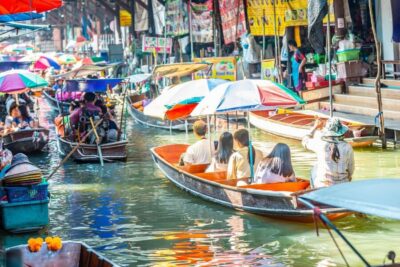
The Old Siam: Damnoen Saduak and Maeklong Railway Market
Read our review →Train Market & Floating Market with Boat Ride
Read our review →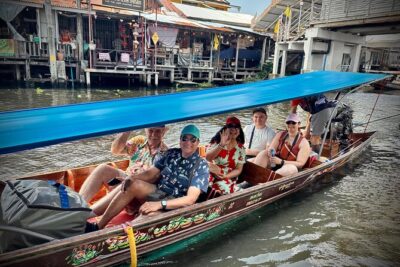
Ayutthaya & Ayothaya Floating Market Day Trip
Read our review →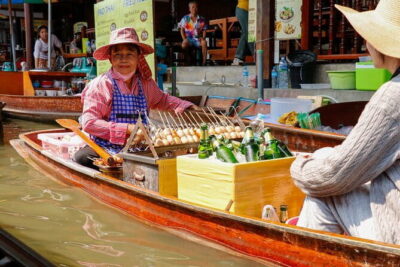
Half-Day Railway Market and Floating Market Tour in Thailand
Read our review →
Cooking Class Hoi An:Local Market, Basket Boat, Fishing & Cooking
Read our review →
Market Tour, Basket Boat Ride and Cooking Class
Read our review →Browse the lists this tour appears in